
NDIS Provider Registration: Why Choosing a Registered Provider Matters
Choosing who supports you under the National Disability Insurance Scheme is one of the most important decisions a participant or family will make. The provider you select shapes your daily routine, your safety, and the long-term progress toward your goals. Yet many people are surprised to learn that not every NDIS provider is held to the same standard. Some are registered and audited by an independent regulator; others operate without that oversight.
With major reforms now reshaping the sector, understanding the difference between a registered and an unregistered provider has never mattered more. This guide explains what NDIS registration actually involves, why mandatory NDIS registration is changing the landscape in 2026, and what the real risks are if you choose an unregistered provider.
What Does It Mean to Be a Registered NDIS Provider?
A registered NDIS provider is an organisation that has been formally approved by the NDIS Quality and Safeguards Commission, the independent body responsible for regulating providers across Australia. Registration is not a one-off badge. It is an ongoing commitment to meeting strict quality and safety benchmarks.
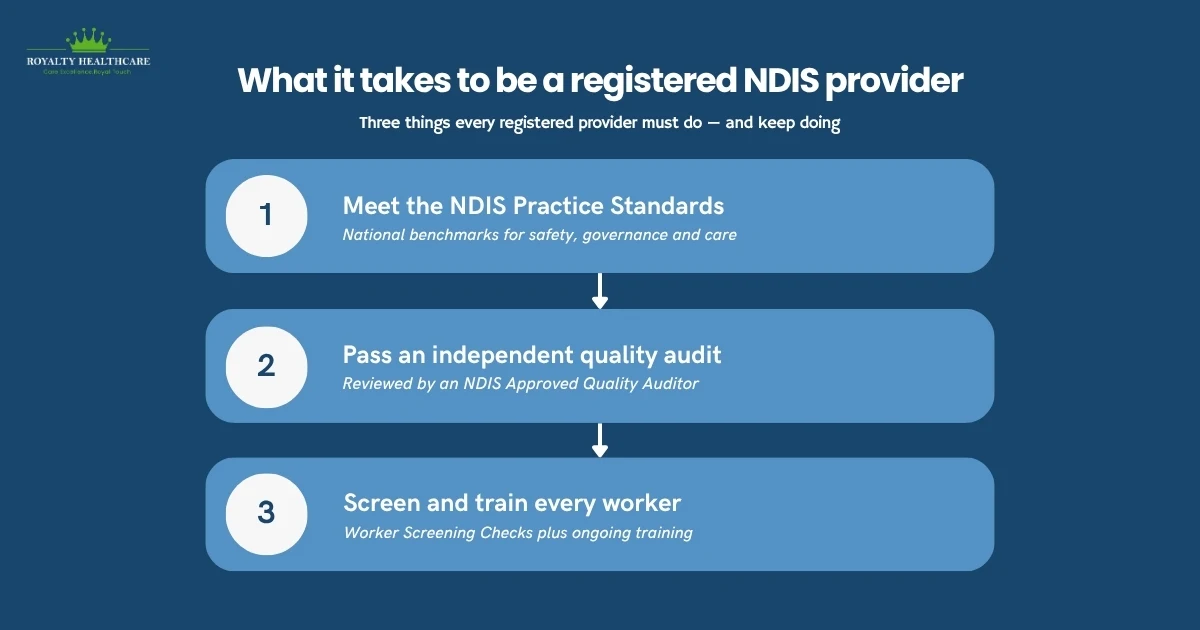
To become and stay registered, a provider must:
- Meet the NDIS Practice Standards. These are the national benchmarks covering everything from rights and responsibilities to governance, service delivery, and the management of high-intensity supports.
- Pass an independent quality audit. A provider engages an NDIS-approved quality auditor who reviews policies, procedures, and in many cases visits the service on-site. Higher-risk supports require a more thorough certification audit rather than a simple desktop review.
- Screen and train every worker. Registered providers must ensure staff hold a current NDIS Worker Screening Check, complete the NDIS Worker Orientation Module, and receive ongoing role-specific training.
- Maintain a complaints and incident system. There must be clear, documented channels for raising concerns, with the right for participants to escalate directly to the Commission.
At Royalty Healthcare, every one of these requirements is met as a fully registered NDIS provider Brisbane families have trusted since 2019. You can confirm any provider’s registration status through the official NDIS Commission provider register, which is always worth checking before signing a service agreement.
Why Mandatory NDIS Registration Is Changing in 2026
For most of the NDIS’s history, registration has been optional for many support types. Plan-managed and self-managed participants have been able to engage unregistered providers, and only certain higher-risk supports such as Specialist Disability Accommodation, plan management, and specialist behaviour support required registration. That is now changing.
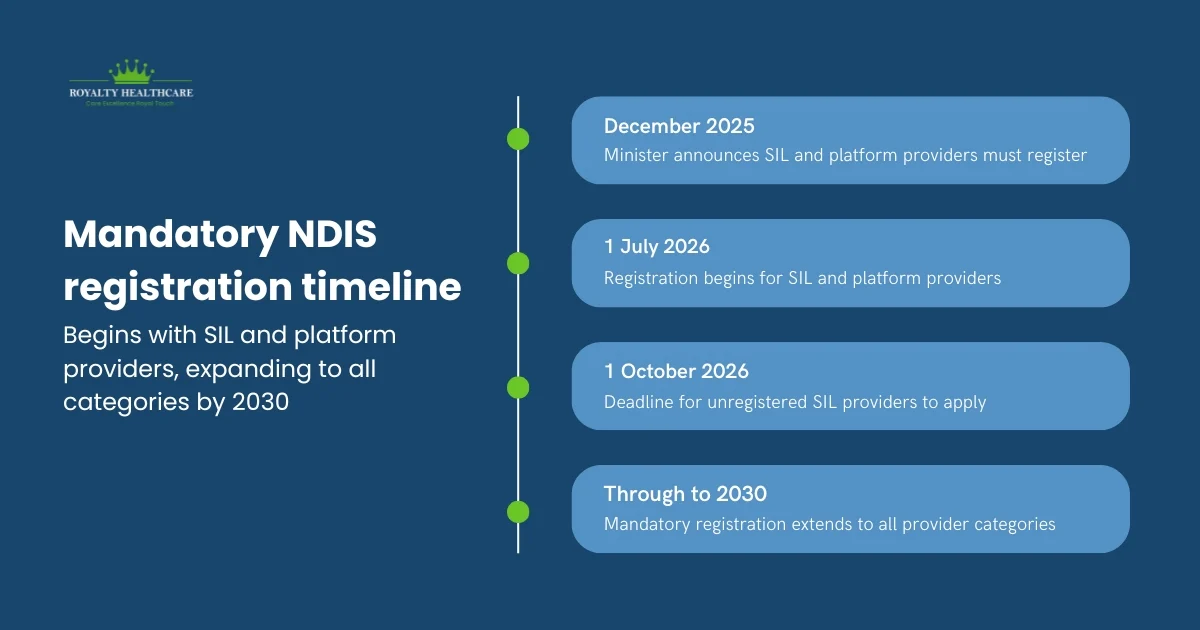
In December 2025, the Minister for the NDIS announced that SIL and platform providers must register with the NDIS Commission from 1 July 2026. This reform follows years of investigation, including the Disability Royal Commission and the NDIS Review, both of which identified safeguarding gaps in higher-intensity supports delivered in people’s homes and in closed settings.
The practical effect is significant. Unregistered providers in these categories will no longer be able to deliver these supports, which directly affects participants who rely on Supported Independent Living or online platform providers. A new registration group specifically for SIL is being introduced, with currently unregistered SIL providers required to apply for registration by 1 October 2026 to continue delivering SIL supports.
This is only the beginning. A broader mandatory registration program will progressively extend to all provider categories through to 2030, backed by substantial new integrity funding. In other words, registration is moving from the exception to the expectation across the entire scheme.
It is worth understanding the scale of what is changing. As of Q1 2025-26, there were 17,374 registered providers and 257,318 unregistered providers, meaning registered providers represent approximately 6% of the market. The reforms are designed to bring far more of the sector under formal oversight, and participants who choose a registered provider now are unlikely to face disruption later.
Importantly, even where registration remains optional for the moment, “unregistered” does not mean “unregulated”, and the NDIS Commission retains oversight under the NDIS Code of Conduct. However, the Code alone offers far weaker assurances than full registration, which is exactly why the reforms are tightening the rules.
The Real Risks of Choosing an Unregistered NDIS Provider
The difference between a registered and an unregistered provider becomes most obvious when something goes wrong. Below are the key unregistered NDIS provider risks every participant and family should weigh carefully.
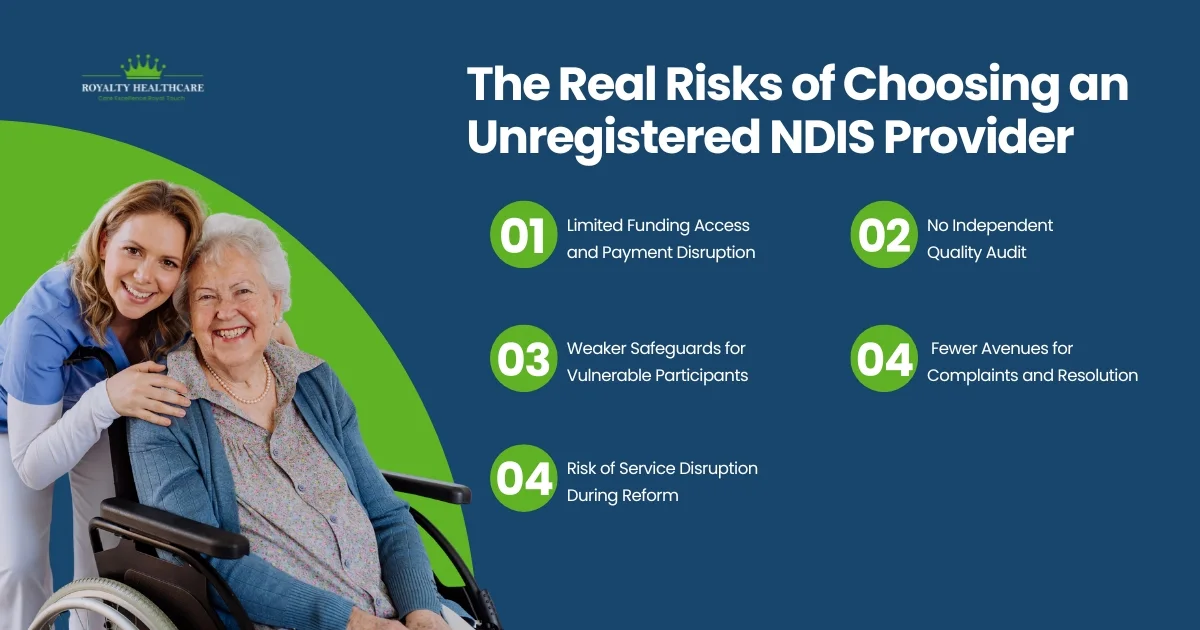
1. Limited Funding Access and Payment Disruption
The most immediate risk is financial. Unregistered providers can generally only work with participants who self-manage or plan-manage their funding they cannot serve NDIA-managed participants at all. If your plan management arrangement changes, an unregistered provider may suddenly be unable to support you. With the 2026 reforms, this risk intensifies: providers who fail to register in the affected categories will simply stop being paid for those supports, forcing participants to scramble for alternatives.
2. No Independent Quality Audit
An unregistered provider has not had its systems tested against the NDIS Practice Standards by an independent auditor. There is no external verification that its care planning, medication management, or complex care procedures meet a national benchmark. You are effectively relying on the provider’s word alone, with no third party checking behind the scenes.
3. Weaker Safeguards for Vulnerable Participants
The reforms exist for a clear reason. People with disability are at higher risk when they access services with low regulation and oversight, particularly in settings like supported accommodation or overnight care. Unregistered providers are not bound by the same incident reporting, restrictive practice, and worker screening obligations, which can leave participants exposed in precisely the situations where protection matters most.
4. Fewer Avenues for Complaints and Resolution
With a registered provider, you have a documented complaints process and a clear right to escalate to the NDIS Commission. While the Commission can still investigate Code of Conduct breaches by unregistered providers, the formal structures, timeframes, and accountability mechanisms that registration guarantees are simply not as robust.
5. Risk of Service Disruption During Reform
As mandatory registration expands, participant plans in affected categories are increasingly being locked to registered-only supports. Choosing an unregistered provider now may mean facing a forced transition later at a stressful moment, and often with little notice. Continuity of care, especially for people with complex needs, is far better protected by choosing a registered provider from the outset.
How a Registered Provider Protects Your Plan and Your Goals
Registration is ultimately about trust. When you choose a registered provider, you gain assurance that your funding is protected, your supports meet a national standard, and your safety is backed by independent oversight. For participants with complex or high-intensity needs such as those requiring nursing, behaviour support, or 24/7 care that assurance is not a luxury. It is essential.
A registered provider also delivers practical continuity. Because services like Supported Independent Living (SIL), Short Term Accommodation, nursing, and behaviour support are all delivered under one registered roof, your support workers, coordinators, and clinicians work as a single accountable team. That coordination is much harder to guarantee when supports are pieced together from unregistered sources.
It is also worth remembering that you are always free to choose. You can switch NDIS providers at any time, and your funding stays with you, not your current provider. If you are reviewing your supports ahead of the 2026 changes, that flexibility means there is no reason to remain with a provider who cannot offer the security of registration.
Making the Right Choice for Your NDIS Support
The direction of the NDIS is clear: stronger oversight, higher standards, and registration becoming the norm rather than the exception. For participants and families, the message is reassuring rather than alarming. Choosing a registered NDIS provider Brisbane families can rely on is the simplest way to protect your funding, safeguard your wellbeing, and avoid the disruption that the coming reforms will create for those who delay.
If you are new to the scheme, comparing providers, or simply want to understand what your plan can cover, the best first step is an honest conversation with a provider who can show you exactly where they stand.