
NDIS Changes Explained: What Brisbane Participants & Families Need to Know
If you or someone you love receives support through the National Disability Insurance Scheme, you have probably heard that big changes are coming. Across Brisbane, from Chermside to Logan, Ipswich to the Bayside suburbs, participants, families, and carers are asking the same questions: What do these NDIS changes actually mean? Will my funding be cut? Do I need to do anything right now?
The short answer is reassuring: your current plan continues as normal for now. The longer answer is that a significant set of NDIS reforms is being rolled out in stages between 2026 and 2029, and understanding them early puts you in the strongest position. This guide explains the new NDIS rules in plain English, with a Queensland lens, so you can plan with confidence rather than worry.
Understanding the 2026 NDIS Reforms
The NDIS is going through its biggest overhaul since the scheme began. To understand why and what is changing, it helps to look at the drivers and then the specific reforms.
Why are the changes happening
The Federal Government has argued that the scheme is growing faster than intended. With more than 760,000 current participants, nearly double the original design and costs passing $50 billion annually, the Government has said the NDIS is “growing too fast.” The stated aim of the reforms is to return the scheme to its original intent: supporting Australians with permanent and significant disability, while keeping it sustainable for future generations. (Source: Department of Health, Disability and Ageing — Securing the NDIS for future generations.)
To set the direction legally, the Government introduced the National Disability Insurance Scheme Amendment (Securing the NDIS for Future Generations) Bill to Parliament on 14 May 2026. This legislation underpins many of the eligibility and oversight changes still to come. (Source: Department of Health, Disability and Ageing.)
The key NDIS changes Brisbane participants should know
Several distinct reforms are being introduced on a staggered timeline. The most important things for participants and families are:
1. A new NDIS planning framework is coming
Following consultation with people with disability and their families, carers and advocates, the rollout of new framework planning has been delayed until 1 April 2027. The extra time is meant to test the new rules and processes and to share clearer information before anyone transitions. (Source: NDIS — Securing the NDIS for future generations.)
2. Support needs assessments will set your budget
Under the new model, a structured assessment replaces the current way budgets are built. This assessment looks at a person’s support needs based on their functional capacity, life stage and environmental factors, and is used to help create NDIS plan budgets but it will not be used to decide whether someone can access the NDIS. (Source: Department of Health, Disability and Ageing — New framework planning.)
3. The budget structure is being redesigned
The familiar three-budget model is being reshaped. In new framework plans, funding will be provided either as a stated item which must be used for a particular support or as part of a flexible budget that can be used flexibly across NDIS supports. (Source: NDIS — Update: a new way of planning.)
4. Some community participation budgets will change first
From 1 October 2026, some social and community participation support budgets are expected to change as participants’ plans are reassessed or renewed. Critically, the Government has said this reset is not intended to affect budgets for essential daily supports such as help with eating, dressing, toileting, personal care and community nursing. (Source: Better Care Delivered — NDIS changes for current participants.)
5. Tighter eligibility and system boundaries
Changes to the boundaries between the NDIS and mainstream systems will apply to prospective participants from 1 January 2028, with current participants reassessed over a transition period. Eligibility is moving toward standardised, evidence-based assessments of functional capacity rather than diagnosis alone. (Source: Department of Health, Disability and Ageing; Disability Support Guide.)
6. Stronger fraud and provider oversight
The reforms place heavy emphasis on integrity, with enhanced claim validation and tighter compliance expectations for providers, measures designed to reduce fraud, improve service quality, and protect participants.
The transition timeline at a Glance
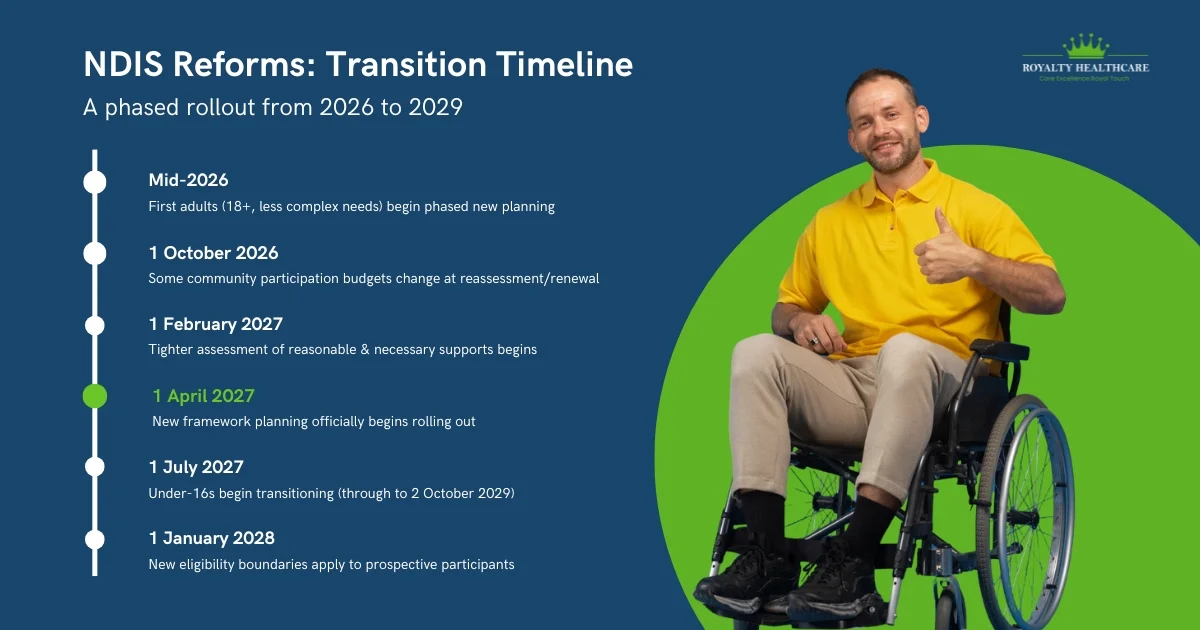
Because the changes are phased, it helps to see how they line up:
- Mid-2026: The first participants, adults over 18 with less complex needs, begin experiencing elements of the new planning approach as a phased introduction.
- 1 October 2026: Some social and community participation budgets begin to change at reassessment or renewal.
- 1 February 2027: Tighter assessment of reasonable and necessary supports begins to be progressively implemented.
- 1 April 2027: New framework planning officially begins rolling out.
- 1 July 2027: Participants under 16 begin transitioning, with the process running through to 2 October 2029.
- 1 January 2028: New eligibility boundaries apply to prospective participants.
It is worth remembering that the new framework has been delayed more than once already. It was originally scheduled for mid-2025, then mid-2026, before the Government confirmed a revised start no earlier than 1 April 2027. Dates can shift, so staying informed matters. (Source: Just Better Care — New Framework Planning Delayed Until April 2027.)
What Brisbane Participants and Families Should Do Now
The reforms can feel overwhelming, but the practical reality for most people in Brisbane today is calmer than the headlines suggest. Here is how to respond sensibly.
Your current plan still applies
This is the single most important point. The NDIA has stated that participants can continue using their current plans for now and do not need to take immediate action, because current rules and planning arrangements remain in place until after the law is passed. Existing plans continue until your next reassessment or renewal, and many participants will not see anything different for some time. (Source: NDIS — Update: a new way of planning.)
In other words: don’t panic, don’t rush, and keep using your funded supports as you normally would.
Practical steps to prepare with confidence
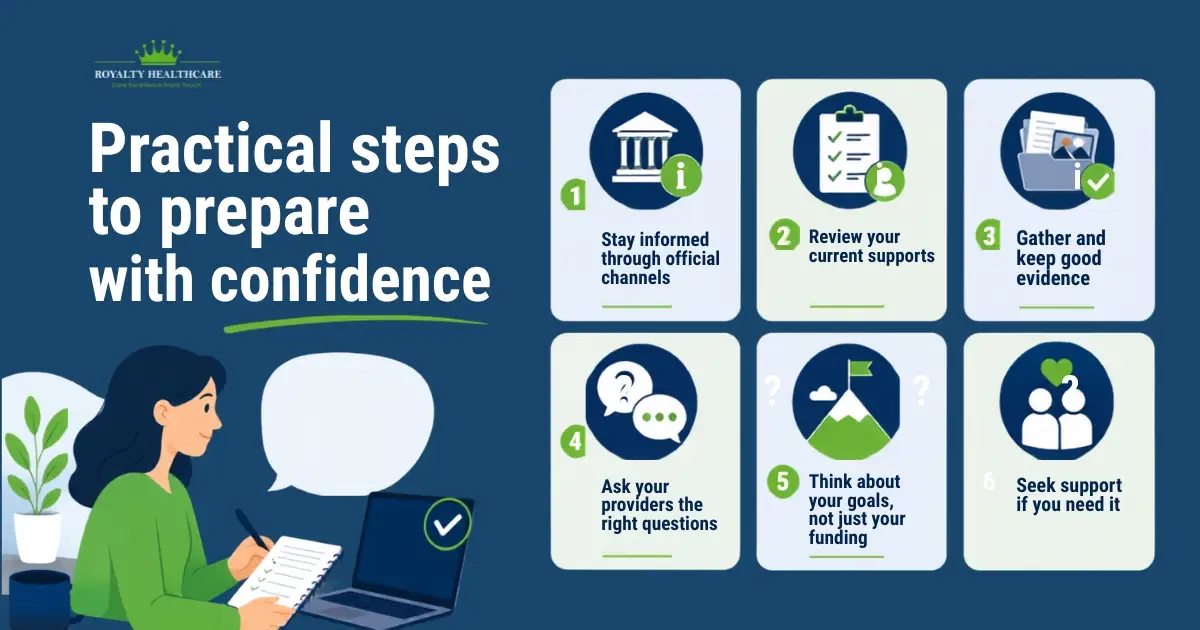
While “nothing changes right now” is true, it does not mean “ignore it.” A measured, informed approach is best. Consider these steps:
1. Stay informed through official channels
Rely on verified information rather than social-media rumours. The official NDIS website and the Department of Health, Disability and Ageing publish updates as rules are finalised, and free Understanding the NDIS information sessions are available for participants, families and carers.
2. Review your current supports
Take time to understand what is in your plan now and which supports are most essential to your goals and independence. Knowing your priorities makes the eventual support needs assessment far less daunting.
3. Gather and keep good evidence
As assessments become more standardised and evidence-based, up-to-date reports from your treating professionals, GPs, therapists, and specialists become more valuable. Keep these organised and current.
4. Ask your providers the right questions
Find out how prepared your provider is for the reforms, how they manage compliance, and how they will support continuity of your care through the transition. Research published by UNSW Sydney highlights that continuity of care and participant choice remain among the strongest predictors of positive outcomes for people living with disabilities. (Source: UNSW Sydney disability research.)
5. Think about your goals, not just your funding
The new planning approach centres on your support needs in the context of your daily life. Reflecting on what a good life looks like for you at home, at work, and in your Brisbane community will help you articulate your needs clearly.
6. Seek support if you need it
If you feel uncertain, a quality local provider, support coordinator, or advocate can help you interpret changes as they apply to your individual situation.
Choosing the right provider matters more than ever
With greater emphasis on accountability and participant outcomes, the provider you choose becomes a bigger factor in how smoothly you navigate the changes. When selecting an NDIS provider in Brisbane, look for organisations that are prepared, compliant, transparent about the reforms, and genuinely committed to your long-term wellbeing and independence.
At Royalty Healthcare, our Brisbane-based team stays across every stage of these reforms so you don’t have to navigate them alone. As a trusted NDIS provider in Brisbane, we can help you understand how the new NDIS rules may affect your plan and support you to keep working toward your goals throughout the transition. To talk through your situation, get in touch with our team.
A note on staying calm and informed
The best mindset through this period is steady and proactive: stay calm, stay informed, and ask good questions. Some reforms are still in consultation, some depend on final legislation, and individual circumstances vary widely. Nothing replaces advice tailored to your specific plan.
Final Thoughts
The NDIS reforms represent real and meaningful change, but they are being introduced gradually and with significant input from the disability community. For Brisbane participants and families, the priorities right now are simple: keep using your current plan, understand what is coming, organise your evidence, and choose a provider who is ready to walk alongside you.
By understanding the new NDIS planning framework today, you put yourself in the strongest possible position for tomorrow. If you would like personalised guidance on what these changes mean for you, the team at Royalty Healthcare is here to help.
This article provides general information only and is current as at June 2026. It is not legal, financial or individual NDIS planning advice. Some changes depend on the final passage of legislation, future rules, consultation outcomes and individual circumstances. For guidance specific to your situation, speak with a qualified professional or the NDIA.