

Supporting the Carers: NDIS Respite and Family Support Options in QLD
Behind almost every NDIS participant is a family carer a parent, partner, sibling, or adult child who quietly holds everything together. They manage medications, attend appointments, coordinate services, and provide hands-on care, often around the clock. Yet carers are frequently the most overlooked people in the disability support system. If you are caring for a loved one in Queensland, this guide walks you through the NDIS carer support options available to you, how to access respite for carers in Brisbane, and where to turn when the weight of caring becomes too much.
At Royalty Healthcare, a registered NDIS provider based in Brisbane, we work with family carers every day. We understand that supporting the person you love starts with supporting you.
Why Carer Support Matters More Than Ever
Australia is home to a vast, largely invisible workforce of unpaid carers. According to the Australian Bureau of Statistics Survey of Disability, Ageing and Carers, roughly 2.65 million Australians provide unpaid care to a family member or friend with disability, chronic illness, or age-related frailty. In Queensland alone, hundreds of thousands of households carry this responsibility.
The reality is that caring is deeply rewarding, but it is also demanding. Without regular breaks and proper support, carers face a real risk of physical exhaustion, financial strain, social isolation, and a decline in their own health. This is why carer burnout support is not a luxury; it is essential to the sustainability of care itself. When a carer’s wellbeing collapses, the person they support loses their most important safety net.
The good news is that meaningful support exists through the NDIS, through Australian Government programs, and through local Queensland providers who genuinely understand the caring role.
Understanding the NDIS and the Family Carer
A common point of confusion is who the NDIS is actually for. The scheme funds supports for the participant, the person with disability, not the carer directly. However, the NDIS explicitly recognises the role of informal supports (that’s the official term for family and friend carers) and builds funded supports into a participant’s plan that give carers relief.
In other words, while there isn’t a separate “carer payment” inside an NDIS plan, the right supports in a participant’s plan can dramatically reduce the load on the family carer. NDIS planning conversations should always consider the sustainability of informal supports, and as a carer, you have every right to raise this at a planning meeting or plan review.
Understanding how to translate a participant’s plan into practical relief for the carer is where an experienced provider makes all the difference.
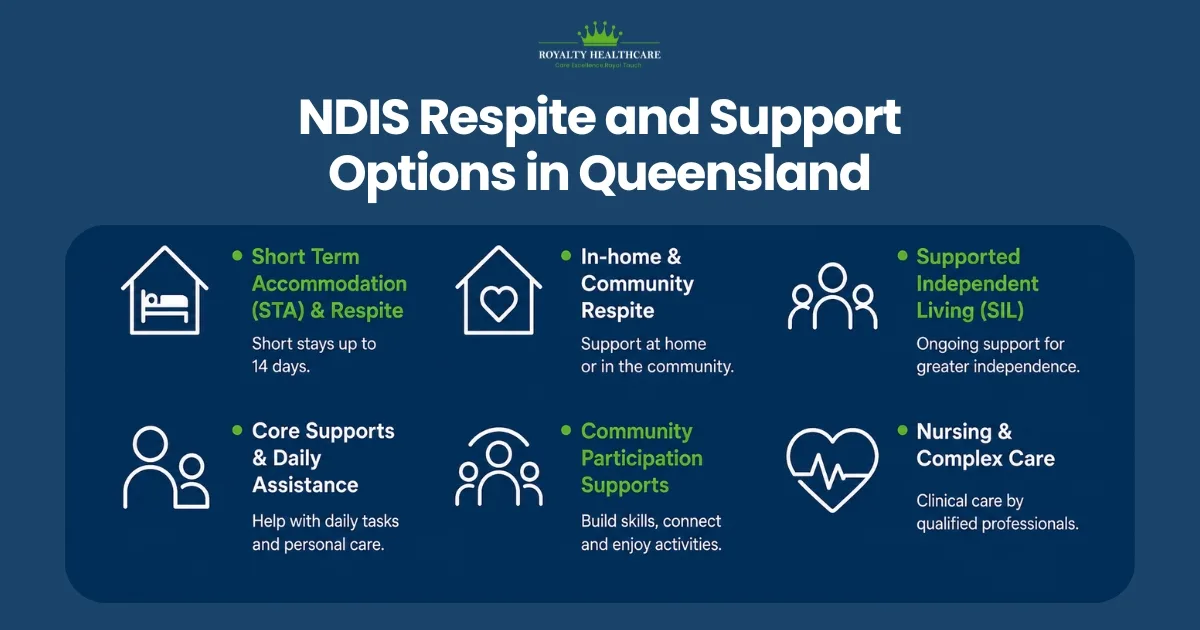
NDIS Respite and Support Options in Queensland
This is the section every carer wants to understand clearly. Below are the main forms of NDIS carer support and respite available to Queensland families, with an explanation of how each one works in practice.
1. Short Term Accommodation (STA) and respite:
STA is the NDIS funding line most people mean when they say “respite.” It covers the cost of a participant staying somewhere else for a short period, typically up to 14 days at a time, including their accommodation, meals, personal care, and activities. For the carer, this means a genuine break: a weekend, a week, or time to recover from illness or attend to other family needs. Royalty Healthcare offers flexible Short Term Respite (STA) stays across Brisbane and South-East Queensland.
2. In-home and community respite
Not every family wants their loved one to stay away from home. In-home respite brings a trained support worker to you, taking over care duties for a few hours or a full day so you can rest, run errands, work, or simply have time to yourself. Community-based options involve a support worker taking the participant out to activities, giving both parties a change of scene.
3. Supported Independent Living (SIL)
For families considering a longer-term arrangement, Supported Independent Living provides ongoing daily support in a shared or individual home. Many carers move towards SIL as their loved one seeks greater independence, or as caring at home becomes unsustainable with age. It offers a stable, structured alternative to full-time family care.
4. Core Supports and daily assistance
A participant’s Core Supports budget can fund support workers to assist with personal care, daily tasks, and community participation. Every hour a support worker spends assisting the participant is an hour the carer isn’t carrying alone; this is often the most practical, everyday form of relief.
5. Community participation supports
Funded community participation helps the participant build social connections and enjoy activities independently. Beyond the benefits to the participant, it creates regular, predictable windows of time when the carer is off-duty.
6. Nursing and complex care
Where a participant has high or complex health needs, funded NDIS nursing and complex care shifts clinical tasks, medication management, wound care, and more to qualified professionals, relieving carers of responsibilities that are stressful and often beyond their training.
Recognising and Responding to Carer Burnout
Burnout rarely arrives all at once. It builds slowly, and many carers don’t notice how depleted they’ve become until they hit a wall. Knowing the warning signs and acting early is the heart of effective carer burnout support. Below are the key indicators to watch for, with an explanation of why each one matters.
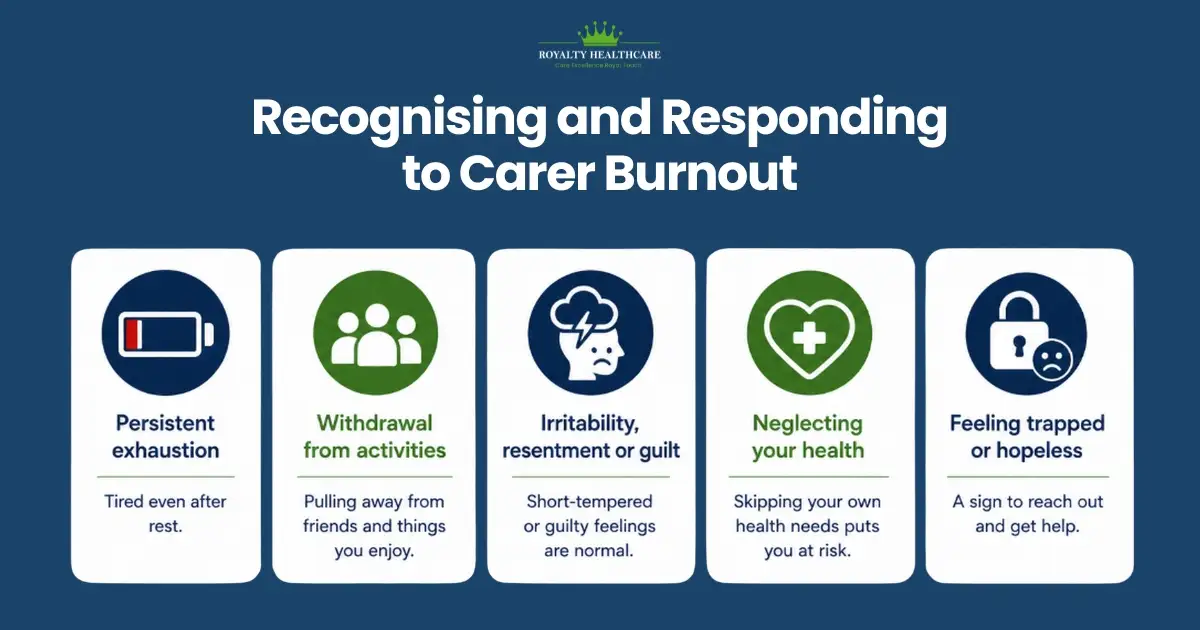
- Persistent exhaustion that rest doesn’t fix: Feeling tired even after sleep is one of the earliest and most reliable signs. Chronic fatigue affects judgement, patience, and physical safety, both yours and the person you care for. If ordinary rest no longer restores you, it’s a signal that the caring load has outgrown your capacity to recover.
- Withdrawal from friends and activities: Caring can gradually crowd out everything else, until social contact disappears entirely. Isolation feeds depression and anxiety, and it removes the very relationships that help carers stay resilient. Noticing that you’ve stopped seeing friends or doing things you enjoy is an important early warning.
- Increased irritability, resentment, or guilt: Feeling short-tempered or resentful doesn’t make you a bad carer; it makes you a human being under sustained pressure. When these feelings are paired with guilt for having them, they create a corrosive cycle. Acknowledging them without shame is the first step to getting support.
- Neglecting your own health: Skipping your own medical appointments, medications, or healthy habits is extremely common among carers, and it’s dangerous. Your health is the foundation of your ability to care. When you find yourself always last on the list, it’s time to build in support that lets you attend to your own needs.
- Feeling trapped or hopeless: A sense that there is no way out, or that things will never change, is a serious red flag that warrants immediate support. These feelings are treatable and, importantly, they are not a personal failing; they are a predictable response to unrelenting demand without relief.
If several of these resonate, please treat it as a prompt to reach out to your GP, to Carer Gateway, or to a provider like Royalty Healthcare who can help put practical relief in place quickly.
Beyond the NDIS: Carer Gateway and Other QLD Support
The NDIS isn’t the only source of help, and importantly, you do not have to be an NDIS participant yourself to access carer support. Several programs support carers directly.
The most important is Carer Gateway, an Australian Government initiative that offers free services to family and friend carers across the country. Through Carer Gateway, you can access counselling, peer support groups, coaching, online skills courses, tailored financial support packages, and crucially respite services, including emergency respite when a crisis hits. You can reach Carer Gateway on 1800 422 737 (Monday to Friday, 8 am–5 pm), with emergency respite available 24/7.
Other valuable Queensland and national supports include:
- Carers Queensland, offering local advocacy, support groups, and information tailored to Queensland families.
- Services Australia payments such as the Carer Payment and Carer Allowance, which provide financial assistance to eligible carers.
- The Young Carers Network, supporting carers aged 25 and under, including the Young Carer Bursary for those balancing study with caring.
Used together, these programs and your loved one’s NDIS plan can form a genuine safety net around the whole family, not just the participant.
How Royalty Healthcare Supports Carers Across Brisbane and SE QLD
Choosing the right provider changes everything for a family carer. As a registered NDIS provider certified by the NDIS Quality and Safeguards Commission, Royalty Healthcare delivers person-centred support across Brisbane, Ipswich, Logan, the Gold Coast, and the Sunshine Coast, all from one coordinated team.
What this means for you as a carer is continuity and trust. The support workers, nurses, coordinators, and behaviour support practitioners who assist your loved one all know each other, and they know your family. That consistency reduces the administrative and emotional labour that so often falls on carers. Whether you need a planned STA break, regular in-home respite, complex nursing support, or a longer-term SIL arrangement, we build the support around your family’s real life, not the paperwork.
Our team also brings culturally sensitive, trauma-informed care to every home we work in, supporting CALD communities, First Nations families, and people from every background. We work with self-managed, plan-managed, and NDIA-managed plans, so whatever your situation, there’s a way forward.
Taking the First Step
Caring for someone you love is one of the most generous things a person can do but you were never meant to do it alone. Whether you’re just beginning to explore NDIS carer support, urgently need respite for carers in Brisbane, or simply want to talk through what your loved one’s plan could cover, help is closer than you think.
Reach out to the Royalty Healthcare team today. Visit our contact page or call us on 1800 467 692 for a friendly, no-pressure conversation about how we can support your family. Because supporting the carer is where good care truly begins.