
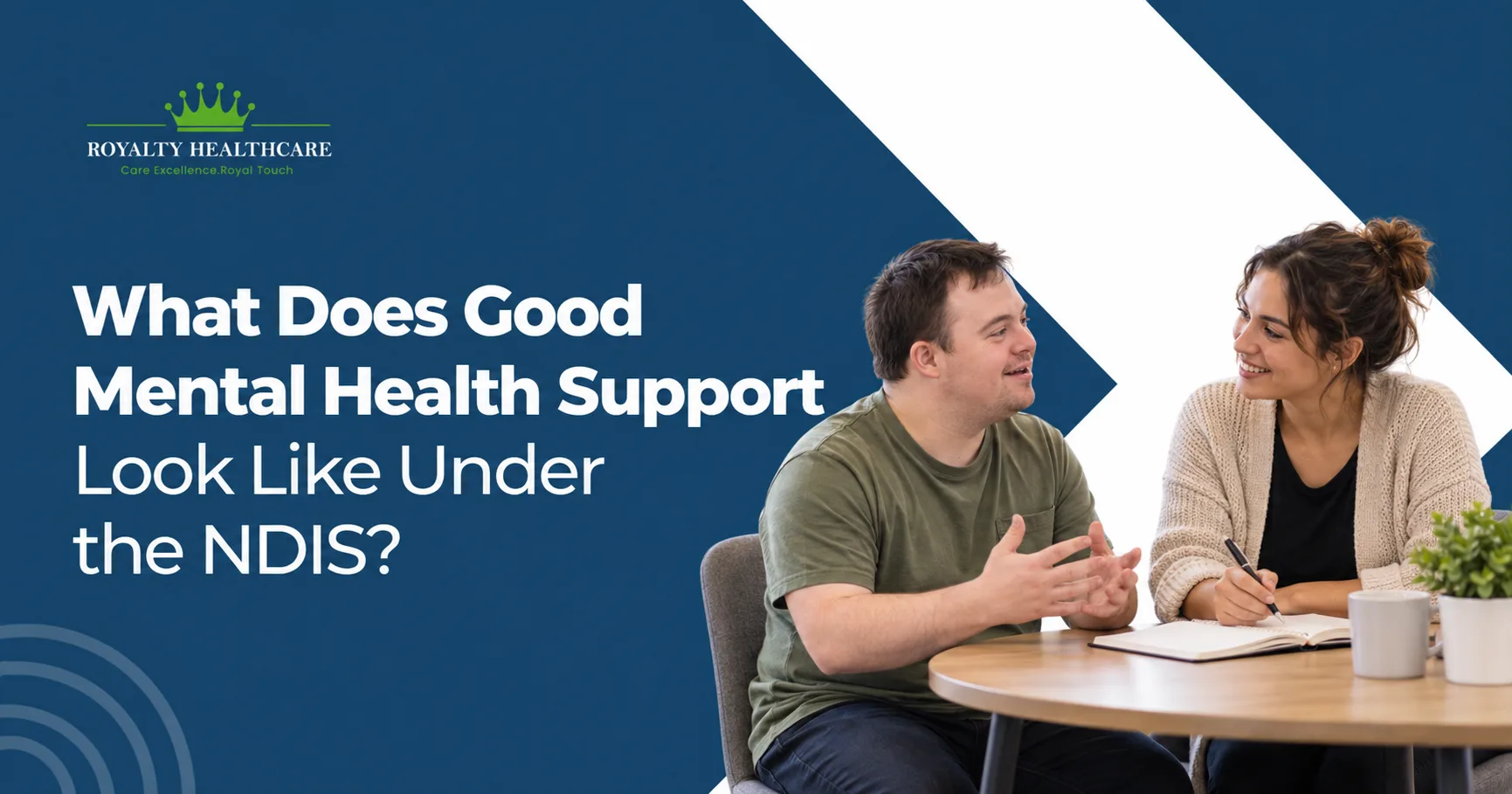
What Does Good Mental Health Support Look Like Under the NDIS?
When an NDIS plan includes funding for mental health supports, it tells you what can be paid for. It doesn’t tell you what good support actually looks like. Two people with almost identical budgets can have completely different experiences: one gains confidence, routine and connection over a year, while the other cycles through new workers and feels no further ahead.
The difference usually comes down to how support is delivered, not how much of it there is. For people living with a serious mental health condition, and the families who stand beside them, knowing what quality looks like makes it far easier to choose well and to speak up when something isn’t working.
At Royalty Healthcare, our Brisbane team supports NDIS participants living with psychosocial disability across South East Queensland. This guide sets out the signs of good mental health support, who delivers it, and the questions worth asking before you commit to a provider.
Where NDIS Support Fits in Mental Health Recovery
The NDIS uses the term psychosocial disability to describe the impact a mental health condition can have on everyday life, such as managing a home, keeping routines, maintaining relationships or taking part in work and study. Not everyone with a mental health condition has a psychosocial disability. What matters is functional impact, not the diagnosis.
It also helps to be clear about roles. The NDIA’s guide to NDIS access for people with psychosocial disability states that the Scheme does not replace community mental health services or treatment through the health system. Your GP, psychiatrist, psychologist and community mental health team remain responsible for clinical care. The NDIS funds psychosocial recovery supports that build functional capacity, independence and participation.
When families search for psychosocial disability NDIS information, most of what they find explains eligibility and funding. If you need that background first, our guides to what NDIS mental health funding covers and eligibility and supporting evidence are a good place to start. This article picks up where they leave off: once the funding is in place, what should the support itself look like?
Seven Signs of Good Mental Health Support
Every plan is built around the participant’s own goals, so no two arrangements look the same. These are the qualities that separate genuinely helpful support from support that simply fills hours.
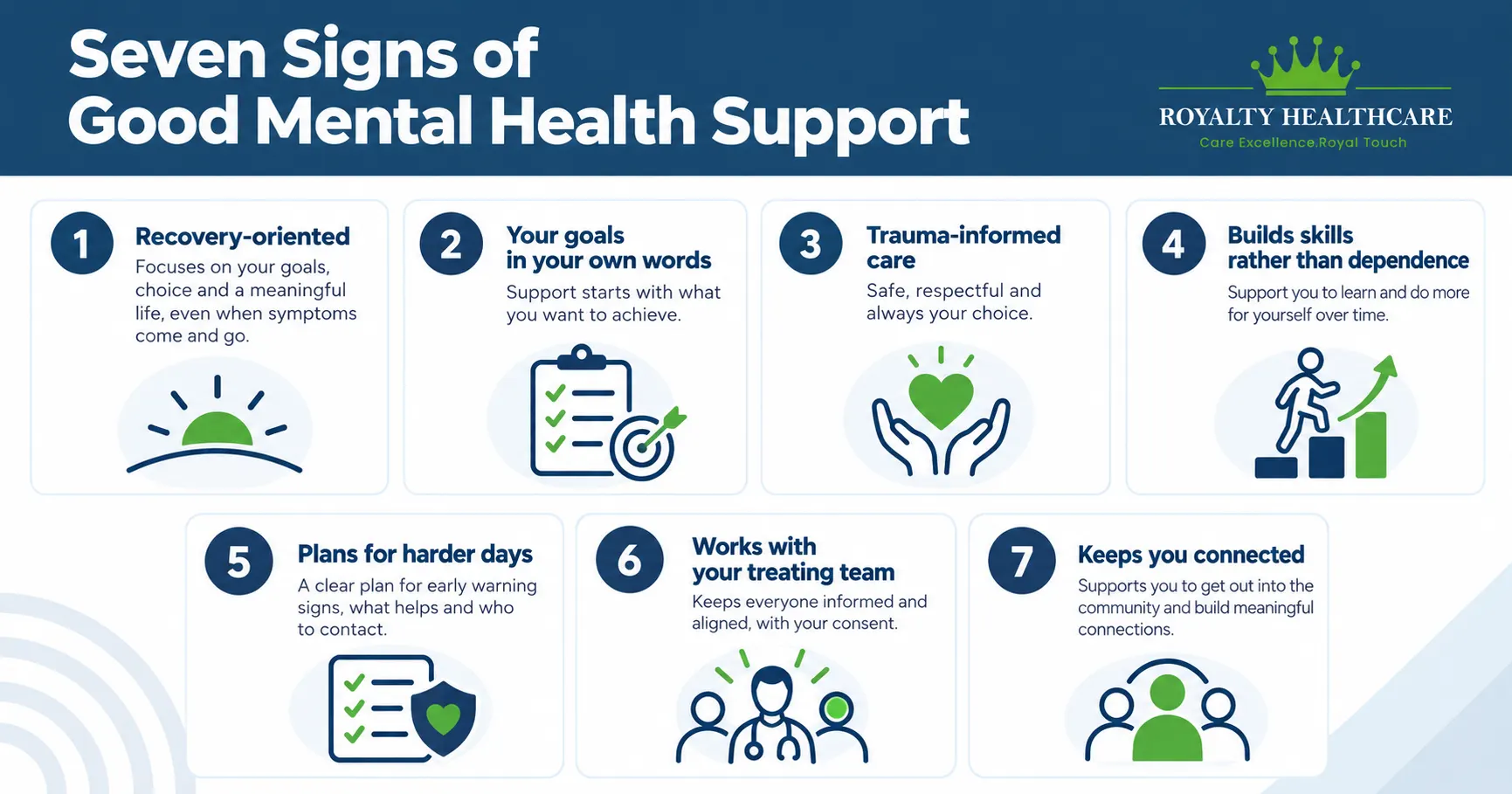
1. It is recovery-oriented
In mental health, recovery doesn’t necessarily mean being free of symptoms. It means living a life that feels meaningful to you, with hope, choice and control, even when symptoms come and go. Australia’s national framework for recovery-oriented mental health services sets out this approach, and good NDIS providers build their practice around it.
2. Your goals are written in your own words
“Catch the bus to TAFE on my own” or “cook dinner twice a week” gives everyone something real to work towards. A generic list of services does not. Good support starts with what you want, then plans backwards from there.
3. It is grounded in trauma-informed care
Many people living with serious mental illness have experienced trauma, sometimes within the very services meant to help them. Trauma-informed care means workers prioritise safety, explain what they are doing, offer real choices and never force the pace. You should feel respected in every interaction, not managed.
4. It builds skills rather than dependence
Early on, a worker may do much of a task alongside you. Over time they should step back, prompting rather than doing, as the skill becomes yours. Our life skills development supports are built around that gradual shift.
5. It plans for harder days
The NDIA recognises that mental health conditions are often episodic, so support needs can rise and fall. Good support includes a written plan covering early warning signs, what helps and who to contact, developed with you and, where you agree, your clinical team.
6. It works with your treating team
With your consent, a good provider shares relevant updates with your GP or psychiatrist and builds their advice into day-to-day support. Where medication is involved, workers follow written instructions from the prescriber rather than their own judgement.
7. It keeps you connected
Isolation and poor mental health tend to feed each other. Supported time in the community, such as a class, a walking group or a volunteering shift, often does as much for recovery as anything that happens at home. Community participation support works best when the worker gradually steps back as confidence grows.
The People Who Deliver Good Support
Mental health support under the NDIS is usually delivered by a small team, and each role does something different.
A mental health support worker is often the person you see most. They help with routines, household tasks, appointments and getting out into the community. The best workers combine practical skills with patience and an understanding of recovery principles, and every NDIS worker in a risk-assessed role must hold a current NDIS Worker Screening Check.
A psychosocial recovery coach is an NDIS-funded role focused on building capacity and resilience. According to the NDIA, a recovery coach helps participants find, plan and organise supports, stay engaged through periods when more help is needed, and connect with mental health services outside the NDIS. The NDIA also notes that some people find it helpful to choose a coach with lived experience.
A support coordinator helps you understand your plan, find providers, and keep services working together. When these roles communicate well, far less falls through the cracks.
Six Questions to Ask Before Choosing a Provider
A first conversation with a provider should feel like a two-way interview. These questions help you look past the brochure.
1. Are you registered, and how are your workers trained?
Registered providers are audited against the NDIS Practice Standards, and every provider and worker must follow the NDIS Code of Conduct. Ask what mental health training workers complete, such as recovery-oriented and trauma-informed practice. Our article on why choosing a registered provider matters explains the difference.
2. Who will actually support me?
Consistency matters more in mental health than almost anywhere else. Ask how workers are matched to participants, how many different workers you can expect, and what happens when your regular worker is away.
3. How will you work with my clinicians?
Listen for a clear answer about consent, communication and how clinical advice is built into daily support. A vague answer here is a warning sign.
4. How will you work with my recovery coach?
If your plan funds an NDIS recovery coach, ask how the provider will work alongside your coach, or whether they can deliver coaching themselves. Either way, your supports should pull in the same direction.
5. How will we track progress?
Regular goal reviews and clear progress notes show what is working. They matter more than ever, because budgets for social and community participation and daily living skills are being reduced for many participants as plans are reassessed or renewed. Linking each support to a goal helps you use funding purposefully and builds evidence for your next plan.
6. How do I raise a concern?
Registered providers must have a complaints process, and you should know exactly who to speak to. If a concern isn’t resolved, you can contact the NDIS Quality and Safeguards Commission on 1800 035 544. You can also change providers, subject to the notice period in your service agreement.
When You Need Help Quickly
NDIS supports are not crisis services. In Queensland, 1300 MH CALL (1300 642 255) is the 24-hour entry point to public mental health services, staffed by mental health clinicians. Lifeline is available around the clock on 13 11 14. If someone is in immediate danger, call Triple Zero (000). Keep these numbers somewhere easy to find, and make sure support workers have them too.
How Royalty Healthcare Supports Mental Wellbeing
Royalty Healthcare is a registered NDIS provider (ABN 35 654 251 519), listed on the NDIS Commission’s Provider Register. From our Strathpine office, we support participants across Brisbane, Ipswich, Logan, the Gold Coast and the Sunshine Coast.
Our mental health support focuses on daily living, life skills, community connection and recovery-focused encouragement that works alongside clinical treatment. Every team member is trained in trauma-informed practice, every support worker holds a current NDIS Worker Screening Check, and we work closely with treating clinicians, support coordinators and families, with the participant’s consent. Because our support workers, nurses and coordinators work as one team, supports stay joined up as needs change.
To talk through mental health support for yourself or someone you care for, call our team on 1800 467 692 or get in touch online.
This article is general information for NDIS participants, families and carers. It is not legal, financial, clinical or medical advice. NDIS rules and processes can change, so always check current guidance with the NDIA, the NDIS Quality and Safeguards Commission, your treating clinicians or your support coordinator before making decisions about care or your plan. If you need urgent help, call 1300 MH CALL on 1300 642 255, Lifeline on 13 11 14 or Triple Zero (000).