
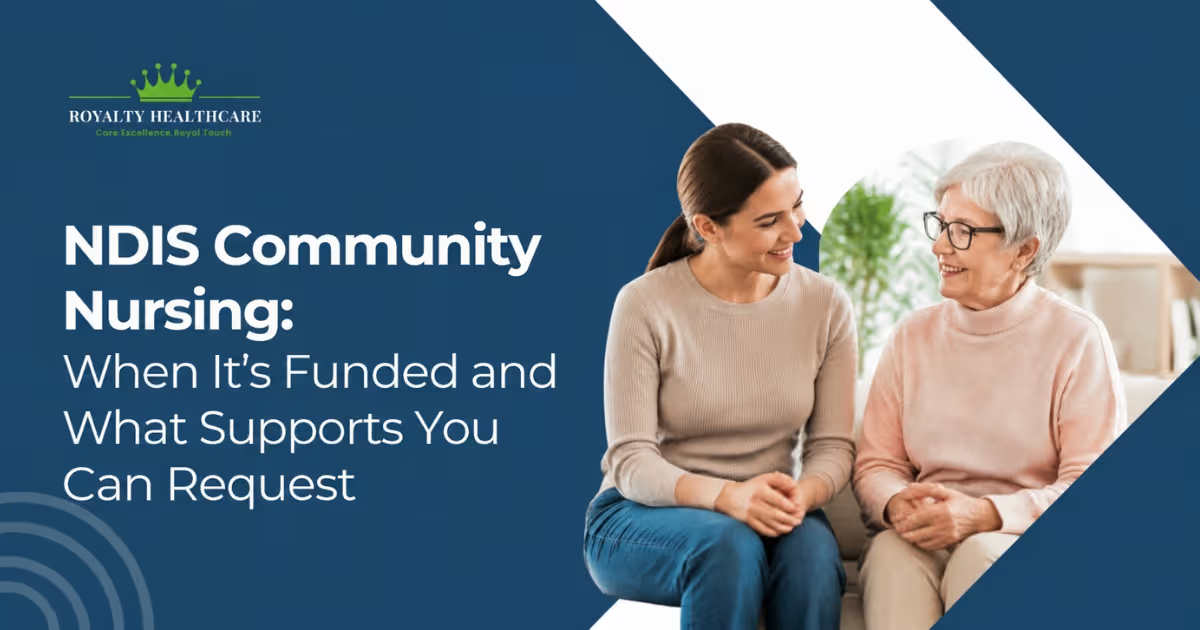
NDIS Community Nursing: When It’s Funded and What Supports You Can Request
For many NDIS participants, the difference between managing well at home and cycling in and out of hospital comes down to one thing: reliable clinical care delivered where they live. That is exactly what NDIS community nursing provides: qualified nurses coming to your home or supported accommodation to manage the health needs that arise directly from your disability.
But community nursing is also one of the most misunderstood areas of the Scheme. Participants and families are often unsure whether nursing belongs in an NDIS plan at all, or whether it is something Medicare and the hospital system should cover. The honest answer is: it depends on why you need the nursing care.
At Royalty Healthcare, our nursing team supports participants across Brisbane, Ipswich, Logan, the Gold Coast and the Sunshine Coast every day, so we see firsthand where the funding lines sit and how to request the right supports with the right evidence. This guide explains when NDIS community nursing is funded, what you can actually ask for, and how to make a strong case at your next planning meeting or plan reassessment.
What Is NDIS Community Nursing?
NDIS community nursing is clinical care delivered by a registered nurse (RN), enrolled nurse (EN) or nurse practitioner in your home or community setting, funded through your NDIS plan. It covers disability-related health needs such as medication management, wound care, catheter care, PEG feeding, and continence support rather than general medical treatment, which remains the responsibility of the mainstream health system.
In practice, community nursing sits within what the NDIS calls disability-related health supports. These were formally brought into the Scheme so that participants would not fall into the gap between the NDIS and the health system. The guiding principle is straightforward: if a health need exists because of your disability, or is made significantly more complex by your disability, and it is part of your day-to-day support, the NDIS can fund it. If it is a general health need that anyone in the population might have, such as a GP visit, a hospital procedure, or dental treatment, it belongs with Medicare and your state health service.
That distinction sounds simple, but it is where most funding requests succeed or fail. So let’s break it down properly.
When Does the NDIS Fund Community Nursing?
The NDIA does not fund nursing simply because a nurse would be helpful. Every funded support must meet the reasonable and necessary criteria under the NDIS Act, and nursing supports must also pass the disability-related health supports test. Here are the key conditions, point by point:
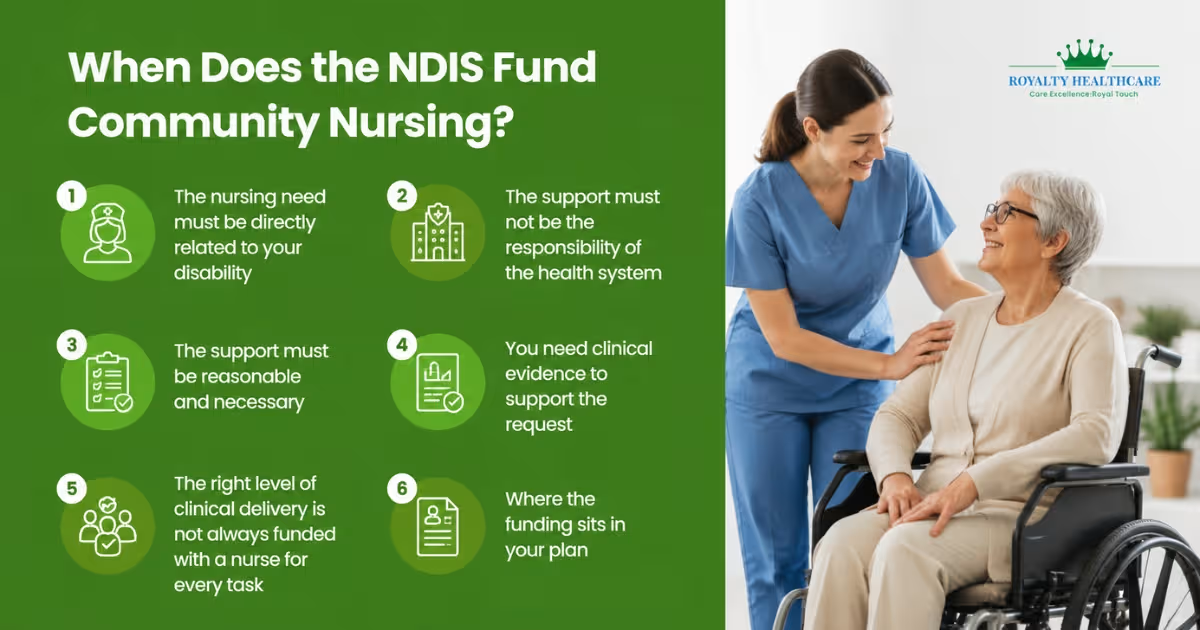
1. The nursing need must be directly related to your disability
This is the foundation of every approval. The NDIS funds nursing when the care requirement is a regular, ongoing consequence of your disability, for example, catheter care because of a spinal cord injury, PEG feeding because of dysphagia linked to cerebral palsy, or pressure-area care because you use a wheelchair full-time. A useful self-check drawn from the NDIS’s own guidance on disability-related health supports: Is the support needed because of your disability? Is it part of your daily life rather than a one-off medical treatment? Would you need it even when you’re otherwise well? If the answers are yes, you likely have a fundable disability-related health support.
2. The support must not be the responsibility of the health system
Under NDIS law, the Scheme cannot fund services the health system already provides: hospital care, ambulance transport, medicines, diagnosis and clinical treatment of health conditions, or time-limited post-surgical care. A classic example: a participant recovering from knee surgery needs two weeks of wound dressing changes. That is post-acute care, and it belongs to the hospital-in-the-home program, not the NDIS. But if the same participant has a chronic pressure wound caused by immobility related to their disability, ongoing community nursing for that wound is squarely an NDIS matter. Understanding which side of the line your need falls on and framing your request accordingly makes an enormous difference at planning meetings.
3. The support must be reasonable and necessary
Like every NDIS support, nursing must represent value for money, be effective and beneficial, help you pursue your goals, and be something the Scheme (rather than family, community or another system) should reasonably fund. The NDIA will consider whether there is a more cost-effective way to achieve the same outcome. This is why nurse delegation matters so much (see point 5) a planner may fund an RN to train and supervise your existing support workers rather than fund daily nurse visits for tasks a trained worker can safely perform.
4. You need clinical evidence to support the request
Funding follows evidence. To get community nursing into your plan, you will typically need letters or reports from your treating GP, specialist, or hospital team describing the clinical task, its frequency, why it relates to your disability, and why a qualified nurse (or nurse-trained worker) is required. For high-intensity supports such as complex bowel care, enteral feeding, tracheostomy or ventilator management, and subcutaneous injections, the evidence requirements are higher, and the support must be delivered by appropriately trained staff under the NDIS Quality and Safeguards Commission’s practice standards and high-intensity support skills descriptors.
5. The right level of clinical delivery is not always funded with a nurse for every task
The NDIS uses a delegation model. A registered nurse assesses your needs, builds the care plan, and either delivers the care directly or trains and supervises support workers, family members, or carers to deliver routine elements safely. The NDIS can fund both the RN’s time (assessment, training, supervision, reviews) and the support worker’s time at the appropriate skill level. This model keeps care safe and sustainable, and demonstrating that you understand it strengthens your funding request, because it shows the planner your proposal is value for money.
6. Where the funding sits in your plan
Community nursing is usually funded under your Core Supports budget (Assistance with Daily Life), particularly for hands-on and high-intensity nursing delivered day to day. Nursing assessments, care plan development and training-focused supports may sit under Capacity Building – Improved Daily Living. Nursing rates are set nationally in the NDIS Pricing Arrangements and Price Limits, with different price caps for enrolled nurses, registered nurses and nurse practitioners. If you are unsure which budget your nursing supports draw from, your support coordinator, plan manager or provider can walk you through your plan line by line.
What Community Nursing Supports Can You Request?
The NDIS groups fundable disability-related health supports into several categories. The list below reflects the supports we deliver most often through our nursing and complex care services, and it is a strong starting point for what you can reasonably request in your plan:
1. Medication management
Support to take medications safely including prompting, administration (where clinically appropriate), Webster pack oversight, monitoring for side effects, and liaising with your GP or pharmacist when something changes. For participants with complex regimes, an RN can also develop a medication management plan and train your support team to follow it consistently.
2. Wound and pressure care
Assessment, dressing and ongoing monitoring of disability-related wounds, plus pressure-injury prevention for participants with limited mobility. This includes skin integrity checks, positioning and equipment advice, and escalation to your GP or specialist when a wound isn’t healing as expected.
3. Continence assessment and support
Bladder and bowel management, continence assessments, development of continence care plans, and support with continence aids and consumables. Continence is one of the eight core disability-related health support categories the NDIS recognises, so well-evidenced requests in this area are common and generally well understood by planners.
4. Catheter care
Insertion, changing and management of urinary catheters (including suprapubic and indwelling catheters), catheter site care, and training for support workers in routine catheter maintenance. Catheter changes generally require an RN, which is exactly the kind of clinical justification planners look for.
5. Complex bowel care
A recognised high-intensity support covering bowel management programs for participants with neurogenic bowel or similar disability-related conditions. Delivery requires staff trained against the NDIS high-intensity support skills descriptors, with RN oversight.
6. Enteral (PEG) feeding and dysphagia support
Safe management of PEG and nasogastric feeding, stoma site care, feed administration, pump management, and training for your regular support workers. For participants with swallowing difficulties, nurses also implement mealtime management plans developed with your speech pathologist.
7. Diabetes management
Blood glucose monitoring, insulin administration or supervision, hypoglycaemia response planning, and education so you and your support team can manage diabetes confidently where your disability makes self-management difficult.
8. Respiratory and tracheostomy support
High-intensity supports, including tracheostomy care and suctioning, ventilator management, and oxygen therapy support delivered by trained staff under clinical governance, in line with your treating team’s instructions.
9. Seizure management
Epilepsy management plans, administration of emergency medication (such as midazolam) by trained staff, seizure monitoring, and post-seizure care are other recognised high-intensity support areas.
10. Health monitoring and nursing assessments
Regular monitoring of vital signs, chronic condition indicators, and general well-being, so small changes are caught before they become hospital admissions. Comprehensive nursing assessments can also generate the clinical evidence you need for plan reassessments.
11. Training and delegation for your support team
RN-delivered training so your support workers or family members can safely perform routine clinical tasks with ongoing supervision and competency reviews. This is often the most cost-effective support you can request, and planners view it favourably.
What the NDIS Will Not Fund
To set realistic expectations, the NDIS will not fund: GP or specialist appointments, hospital or ambulance services, medicines and pharmaceuticals, diagnosis or treatment of general health conditions unrelated to your disability, time-limited post-surgical or rehabilitation nursing, or palliative care (which remains a health system responsibility). If your need falls into these categories, your GP, hospital discharge planner or state health service is the right door to knock on and a good provider will tell you that honestly rather than let you spend plan funds incorrectly.
How to Request Community Nursing in Your Plan: 5 Practical Steps
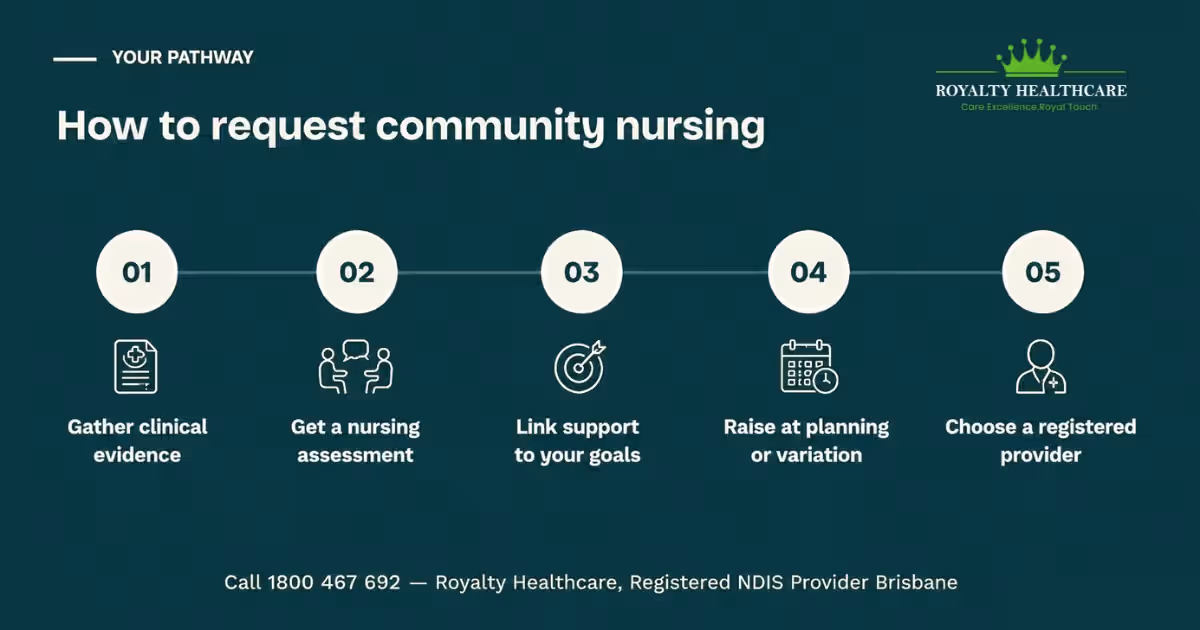
- Gather clinical evidence — ask your GP, specialist or hospital team to document the task, frequency, disability link and required skill level.
- Get a nursing assessment — an RN assessment quantifies your needs and recommends hours, which gives planners something concrete to fund.
- Link the support to your goals — frame nursing as what keeps you healthy, independent and out of hospital, not as generic “medical care.”
- Raise it at your planning meeting or request a plan variation — you don’t have to wait for a scheduled reassessment if your needs have changed.
- Choose a registered provider — nursing and high-intensity supports carry real clinical risk, so work with a provider registered with the NDIS Quality and Safeguards Commission whose nurses and workers are trained, screened and supervised.
Community Nursing with Royalty Healthcare
Royalty Healthcare is a registered NDIS provider based in Strathpine, delivering nursing, complex care and a full range of NDIS support services across Brisbane and South-East Queensland since 2019. Our registered nurses work alongside our support workers, coordinators and behaviour support practitioners as one team so your wound care, medication support and daily living supports are never delivered in silos. We support NDIA-managed, plan-managed, and self-managed participants, and we can coordinate directly with hospital discharge planners when supports need to start quickly.
If you’d like help working out whether community nursing belongs in your plan or what evidence you’ll need to request it, contact our team or call 1800 467 692. We’ll give you a straight answer about what your plan can and can’t cover.
This article is general information only and is not advice about your individual NDIS plan. Funding decisions are made by the NDIA based on your circumstances. For official guidance, see the NDIS pages on disability-related health supports and what is a disability-related health support.