


Complex Care Under the NDIS: A Family Guide to High-Intensity Supports
If someone you love has just come home with a PEG tube, a tracheostomy, or a bowel care routine that has to be followed exactly, the paperwork can feel like the least of your worries right up until the moment it becomes the whole problem. Suddenly there are words in your NDIS plan you have never seen before, workers who can only do some of the tasks, and a hospital discharge nurse asking whether your provider is “Module 1 registered.”
This guide is written for families in that position. It explains what the NDIS actually means by complex care, which supports are covered, how they are funded, where the NDIS stops and Queensland Health begins, and the specific questions that separate a provider who can genuinely deliver this care from one who says they can.
What “complex care” means under the NDIS
Complex care is the everyday term. The NDIS term is high-intensity daily personal activities personal care tasks that carry a real clinical risk if they are done incorrectly, and therefore require workers with participant-specific training and clinical oversight.
These supports are governed by Module 1 of the NDIS Practice Standards, and providers registered to deliver them fall under registration group 0104. The skills and knowledge workers must demonstrate are set out in the NDIS Quality and Safeguards Commission’s High Intensity Support Skills Descriptors, which cover three stages of every task: preparing to deliver the support, following the support plan, and reviewing how it went.
The distinction that matters for families is this: a registered provider can only deliver the specific high-intensity supports listed on its certificate of registration. Being “an NDIS provider” is not the same as being approved for catheter care. Many families discover this only after supports have already started.
The supports that count as high intensity
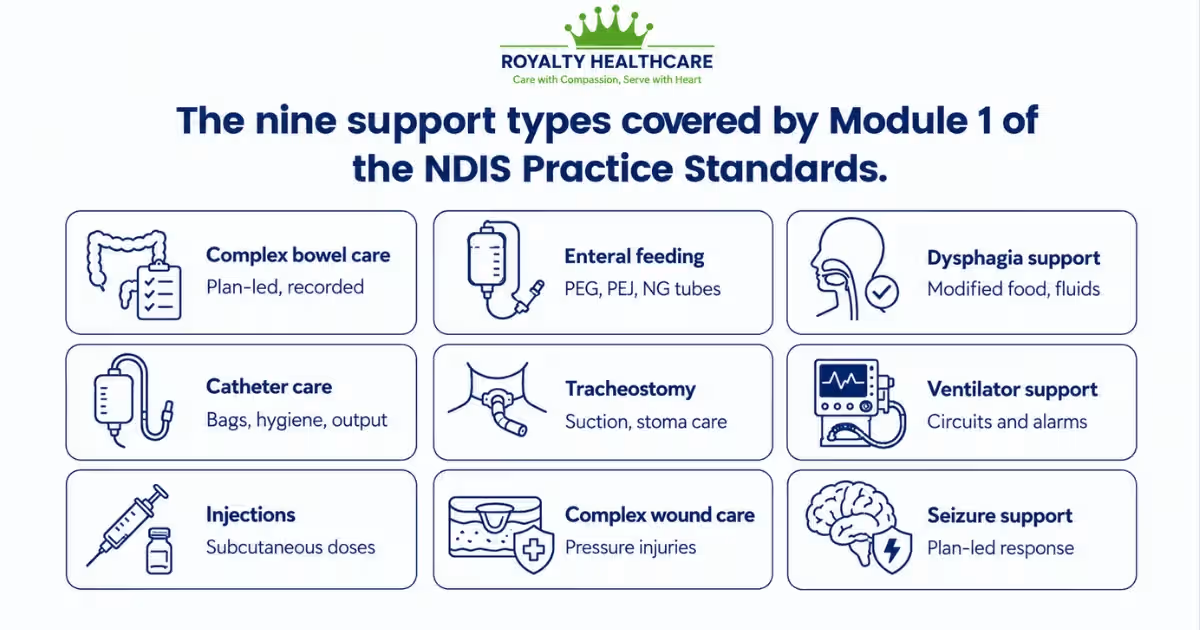
Here are the support types the NDIS Commission treats as high intensity supports, and what each one actually involves day to day.
The nine support types covered by Module 1 of the NDIS Practice Standards.
1. Complex bowel care:
Routines involving suppositories, enemas, digital stimulation or a stoma. Workers must follow a bowel management plan written by a clinician, record outcomes each time, and know the escalation signs, particularly for participants with spinal cord injury, where autonomic dysreflexia is a medical emergency.
2. Enteral feeding (PEG, PEJ and nasogastric tubes):
Delivering nutrition, fluids and medication through a feeding tube. This covers pump set-up and flushing, checking tube placement and stoma site condition, positioning during and after feeds, and responding to blockages or dislodgement. The enteral feeding NDIS requirements are participant-specific: training on one person’s PEG does not authorise a worker to manage another’s.
3. Dysphagia and mealtime support:
Support for people who cannot safely swallow ordinary food or fluids. Workers follow a mealtime management plan from a speech pathologist covering texture-modified food, thickened fluids, positioning and pacing. Aspiration risk makes this one of the highest-consequence supports in the whole scheme.
4. Urinary catheter support:
Day-to-day catheter care, emptying and changing drainage bags, hygiene at the insertion site, monitoring output, and recognising blockage or infection early. Indwelling, suprapubic and intermittent catheters each carry different routines and different risks.
5. Tracheostomy support:
Suctioning, stoma and skin care, humidification, tie changes and inner cannula cleaning, plus knowing the emergency response if a tube becomes blocked or displaced. This support normally requires a nurse-led plan with close, documented competency sign-off.
6. Ventilator support:
Assisting someone who depends on invasive or non-invasive ventilation, including circuit checks, alarm response, backup power planning and a written escalation pathway. Continuity of trained staff matters more here than almost anywhere else.
7. Subcutaneous injections:
Administering prescribed injections such as insulin or anticoagulants, with correct site rotation, sharps handling and documentation, always under a clear medication authority.
8. Complex wound care:
Managing pressure injuries, surgical wounds or chronic ulcers beyond a simple dressing, including repositioning schedules, pressure-relieving equipment and photographic monitoring of healing.
9. Epilepsy and seizure support:
Following a seizure management plan: recognising seizure types, timing them, positioning safely, administering emergency medication where authorised, and knowing exactly when to call an ambulance.
How complex care is funded in an NDIS plan
Most high-intensity personal care is funded from the Core Supports budget, under Assistance with Daily Life. Because the workers need extra training and supervision, these hours carry a higher price limit than standard personal care.
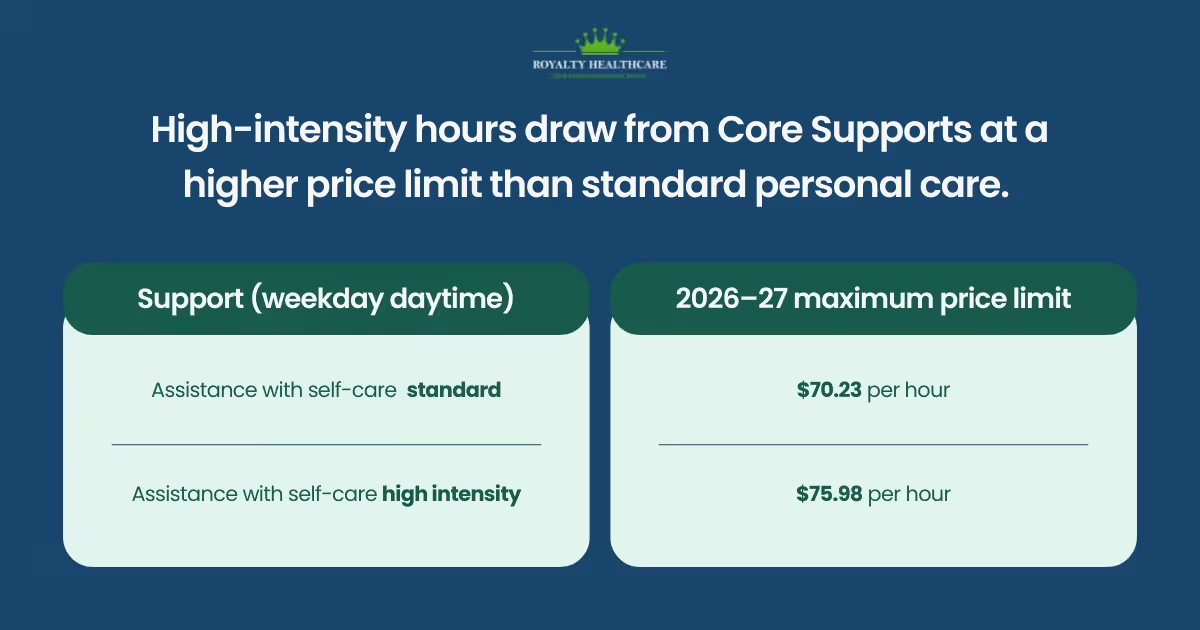
High-intensity hours draw from Core Supports at a higher price limit than standard personal care.
Support (weekday daytime) | 2026–27 maximum price limit |
Assistance with self-care — standard | $70.23 per hour |
Assistance with self-care — high intensity | $75.98 per hour |
Two things families should know about that table. First, these are maximums, not fixed prices; providers may charge less. Second, from 1 July 2026 the NDIA split the old Pricing Arrangements and Price Limits document, and the rates now sit in the NDIS Pricing Schedule, so always check the current pricing page rather than an older PDF.
Beyond personal care, clinical needs may also be funded as disability-related health supports, a category covering continence, dysphagia, nutrition, respiratory, diabetes, epilepsy, wound and pressure care, and podiatry. This is where nursing assessments, care-plan development, worker training and consumables such as feeding sets, catheters and dressings are typically funded. Families arranging NDIS complex care Brisbane supports for the first time often miss this budget entirely and end up paying for consumables out of pocket.
To have these supports included, the NDIA expects clinical evidence: a report from the treating specialist or GP explaining how the health need arises from the disability, and a nursing or allied health assessment setting out the care required, the training workers will need, and how often it must be reviewed.
Where the NDIS stops, and the health system starts
This is the boundary that causes the most confusion, and almost no provider blog explains it.
The NDIS funds ongoing, disability-related health supports that are a regular part of daily life. The health system remains responsible for acute and post-acute care hospital admissions, Hospital in the Home, treatment of a health event, and chronic conditions unrelated to the person’s disability, along with diagnostic and palliative care.
In practice, that means a Queensland Health nurse may manage a wound after surgery while your NDIS-funded team handles the ongoing pressure care that keeps it from recurring. Knowing which system owns which task prevents the two most common failures: a gap where each side assumes the other is covering it, and a plan meeting where funding is refused because the request looked like health care rather than disability support.
Questions to ask before you choose a provider
Checklist of questions families should ask an NDIS complex care provider before signing
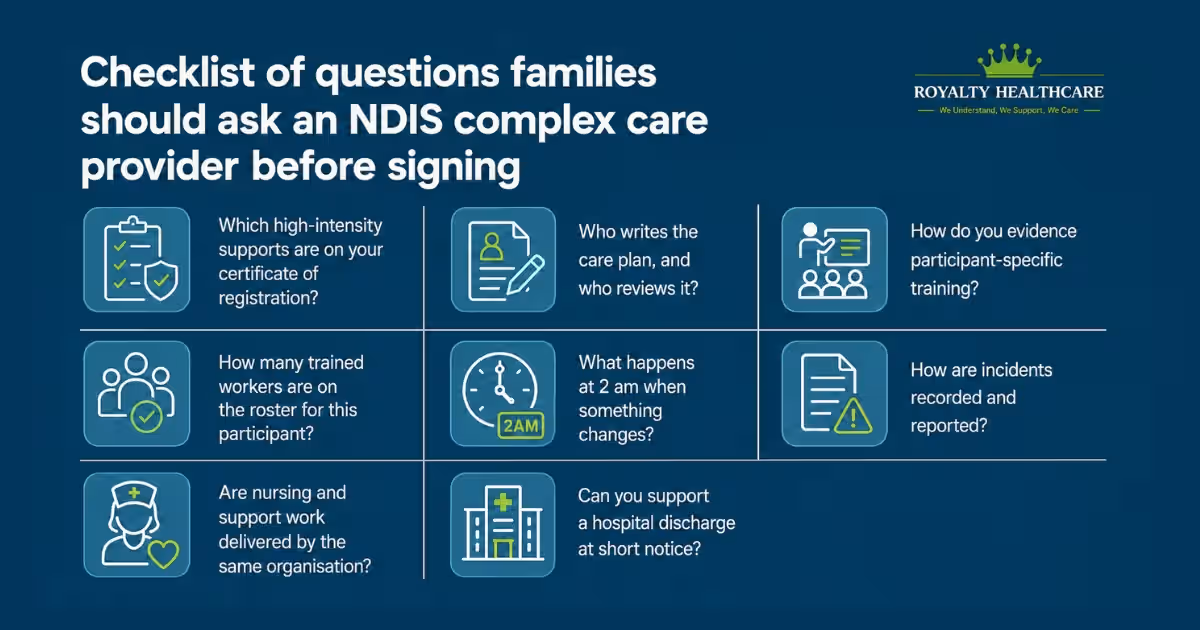
Every provider will say yes when you ask whether they do complex care. These questions tell you whether that yes is real.
1. Which high-intensity supports are on your certificate of registration?
Registration is granted support by support. Ask to see the certificate, and check the provider on the NDIS Commission register yourself. A provider registered for personal care but not for tracheostomy support cannot legally deliver it.
2. Who writes the care plan, and who reviews it?
The plan should be authored or endorsed by a qualified clinician, usually a registered nurse or the relevant allied health practitioner, not written by a rostering coordinator. Ask how often it is reviewed and what triggers an early review.
3. How do you evidence participant-specific training?
Generic online modules are not enough. Ask to see the competency sign-off for the workers who will attend, showing they were trained on this person’s equipment, this person’s plan, and assessed by someone qualified to assess.
4. How many trained workers are on the roster for this participant?
This is the question families most often skip and most often regret. If only two workers are trained on a PEG routine and both are unwell, the shift cannot be safely filled. A credible answer names a depth of at least three to four trained staff plus a plan for surge cover.
5. What happens at 2 am when something changes?
Ask for the escalation pathway in writing: who the worker calls, how quickly a clinician responds, and at what point an ambulance is called. Vague answers here are a genuine red flag.
6. How are incidents recorded and reported?
Providers must have an incident management system, and serious incidents are reportable to the NDIS Quality and Safeguards Commission. Ask how you as a family will be told, and how quickly.
7. Are nursing and support work delivered by the same organisation?
Where NDIS nursing services and daily support come from one team, the nurse who writes the plan can also train and supervise the workers delivering it. Split across two providers, accountability gets blurry, often at the worst moment.
8. Can you support a hospital discharge at short notice?
Ask for a realistic timeframe in business days, and whether the provider will attend a hospital case conference before discharge.
Nurses and support workers: who is allowed to do what
Support workers are not mini-nurses, and a good provider will say so plainly. A trained support worker can deliver a clinical task that has been assessed, planned and delegated by a health practitioner, following the plan exactly. What they must never do is diagnose, change a treatment plan, administer unauthorised medication, or attempt a procedure they have not been trained and signed off on for that specific person.
That boundary is a safety feature, not a limitation. Families should be wary of any worker who is willing to improvise around it and any provider who presents that flexibility as a selling point.
Setting up complex supports after a hospital stay
Hospital discharge is when most complex care arrangements begin, and time is short. What helps: getting the hospital social worker to loop the provider in before discharge rather than on the day; asking for written clinical handover including all care plans and equipment details; confirming consumables and equipment are ordered ahead; and scheduling the first nursing visit within the first 48 hours at home, when small problems are easiest to correct.
How Royalty Healthcare supports Brisbane families
Royalty Healthcare is a registered NDIS provider based in Strathpine, supporting participants across Brisbane, Ipswich, Logan, the Gold Coast and Sunshine Coast. Our registered nurses, behaviour support practitioners and trained support workers deliver complex care and nursing services as one team, so the clinician who writes the plan is the one supervising the people delivering it, whether that care happens at home, in Supported Independent Living, or during a short-term accommodation stay.
If you are comparing providers or preparing for a plan reassessment, we are happy to talk through what your plan currently funds and what evidence would strengthen it. Contact our team for an honest, no-obligation conversation.
This article is general information for NDIS participants and families, not clinical advice. Always follow the care plans provided by your treating clinicians. Pricing and guideline references were checked against ndis.gov.au and ndiscommission.gov.au in July 2026.