
NDIS Community Participation Ideas: Real-World Goals That Build Independence
One of the most powerful and frequently underutilised supports available under the NDIS is community participation. It is not simply a line item in a plan about going out and doing activities. At its best, community participation is a direct pathway to the kind of independence, social connection, and life satisfaction that every NDIS participant deserves and that the scheme was designed to support.
Yet too often, community participation goals are written in vague, generic terms that do not reflect the participant’s actual life, interests, or aspirations. Goals like “increase social participation” look plausible on paper but give neither the participant nor their support worker a meaningful direction to work toward. When goals are not specific, the supports that follow tend not to be either and the potential of community participation funding goes largely unrealised.
This guide changes that. Whether you are a participant exploring your options, a family member helping someone prepare for a planning meeting, or a support coordinator building a community participation framework for a client, this resource gives you the practical ideas, goal-writing insight, and provider evaluation tools to make community participation funding genuinely count.
What NDIS Community Participation Actually Covers
Community participation is funded under the NDIS through two primary support categories: Social, Community and Civic Participation (Core Supports) and Increased Social and Community Participation (Capacity Building Supports).
The Core Supports funding covers the direct cost of a support worker accompanying a participant to community activities covering their time, travel, and in some cases transport costs. Capacity Building funding is aimed at building the participant’s skills and confidence to eventually participate more independently, with less reliance on direct support.
In practice, this means community participation funding can cover an enormous range of activities and goals from learning to use public transport to joining a community sports team, from developing the confidence to attend a social group independently to building the skills to volunteer in the local community. The breadth of what is fundable under community participation is one of its most underappreciated features.
What the NDIS does not fund is recreational activity purely for its own sake, without a connection to the participant’s disability-related goals. This is why goal-setting matters so much the activity itself is rarely the issue, but the way it is framed in the participant’s plan determines whether it is funded and how effectively the support delivers outcomes.
For authoritative guidance on what community participation includes and how it is funded, the NDIS community and social participation resource provides the official framework.
Why Community Participation Matters Beyond the Activities Themselves
The evidence connecting community participation to long-term wellbeing, mental health, and functional independence is compelling and consistent. Social isolation is one of the most significant risk factors for poor health outcomes for people living with disability and it is also one of the most preventable.
When participants are actively involved in their communities attending regular activities, building relationships with people outside their immediate care network, contributing to local organisations, or simply becoming familiar faces in their neighbourhood they develop the kind of confidence, resilience, and social capital that formal therapy and daily living supports alone cannot build.
Community participation also provides a practical environment for developing and consolidating skills that matter in real life: communication, decision-making, problem-solving, managing unexpected situations, using technology, handling money, and navigating social dynamics. These are the skills that build genuine independence and they develop most effectively through real-world practice in real community settings, with the right level of support.
Real-World NDIS Community Participation Ideas by Goal Area
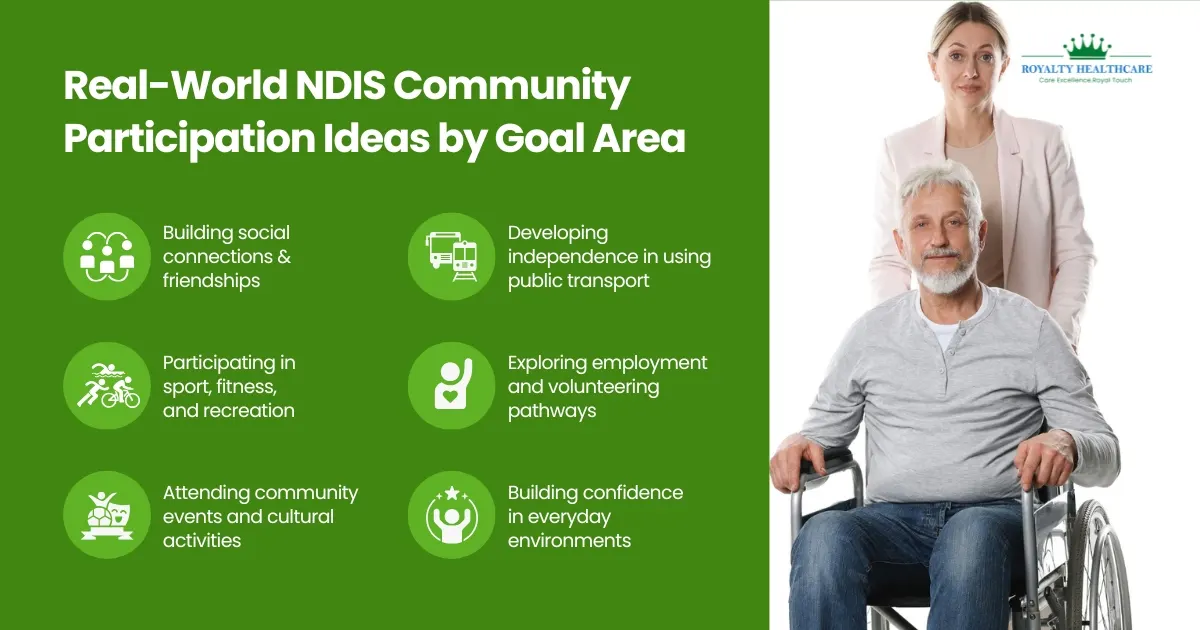
The most effective community participation plans are built around specific, real-world activities that connect directly to what the participant wants their life to look like. Here are practical ideas organised by the independence goals they support:
- Building social connections and friendships. Joining a local interest group whether that is a book club, a board game night, a community choir, an art class, or a photography group provides regular, structured social contact with people who share common interests. The shared activity reduces the social pressure of unstructured socialising and creates natural conversation. For participants working toward social independence, this is one of the most practical and effective starting points.
- Developing independence in using public transport. Travel training is one of the most high-value community participation activities available. Learning to plan a bus or train journey, purchase a ticket, navigate interchanges, and manage delays builds a skill that unlocks access to employment, education, social activities, and healthcare independently. A support worker accompanies the participant initially, progressively reducing their presence as the participant’s confidence grows exactly the kind of capacity-building the NDIS is designed to fund.
- Participating in sport, fitness, and recreation. Joining a local sporting club, attending a community gym, participating in an adapted sport program, or engaging with disability-inclusive recreational activities builds physical health, social connection, routine, and confidence simultaneously. Many communities have disability-inclusive sports programs swimming clubs, athletics groups, bocce teams, wheelchair basketball, and more that provide both the activity and the social structure that supports belonging.
- Exploring employment and volunteering pathways. For participants with employment or vocational goals, community participation can include structured volunteering with a local organisation a community garden, a charity op shop, a library, or a food bank. Volunteering builds work skills, routine, references, and confidence in a low-pressure environment, creating a genuine bridge toward open employment for participants who are working toward that goal.
- Attending community events and cultural activities. Regular attendance at community events markets, festivals, cultural celebrations, religious gatherings, civic activities builds familiarity with community spaces, develops social confidence, and strengthens community belonging. For participants from culturally and linguistically diverse backgrounds, connecting with cultural community groups can also be a powerful source of identity, support, and social connection.
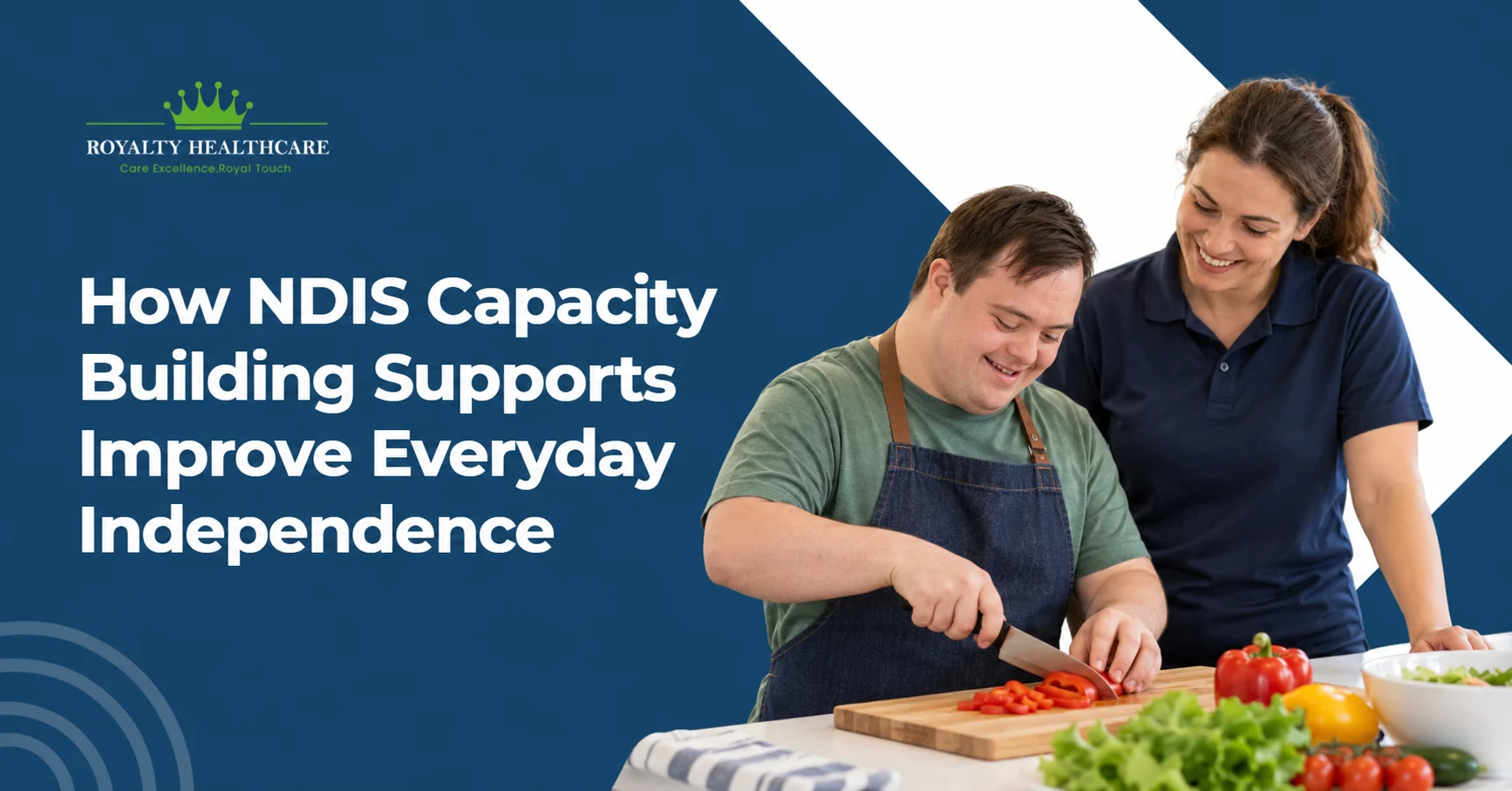
- Building confidence in everyday environments. Supported practice in real-world settings shopping independently at a supermarket, ordering at a café, managing a library card, attending a GP appointment unaccompanied builds the functional independence that matters most in daily life. These activities can be structured as specific community participation goals with measurable progress markers, making them both fundable and demonstrably outcomes-focused.
Writing Community Participation Goals That Get Funded and Deliver Outcomes
The quality of a participant’s community participation goals directly determines the quality of the supports and outcomes they receive. Goals written too broadly give support workers insufficient direction and make it difficult to demonstrate progress at plan review. Goals written too narrowly can feel restrictive and fail to capture the participant’s genuine aspirations.
The most effective community participation goals are specific, connected to a meaningful life outcome, and written in the participant’s own voice. Rather than “increase social participation,” a well-written goal might read: “Attend a local social group at least fortnightly and develop the confidence to participate without a support worker within twelve months.” This goal specifies the activity, the frequency, the desired direction of change, and a realistic timeframe.
At your NDIS planning meeting, come prepared with specific activities you are interested in, the barriers your disability creates to participating in those activities, and a clear explanation of how participation would help you achieve your broader life goals. Support coordinators with strong community knowledge can help you research local options and connect specific activities to fundable outcomes. Royalty Healthcare’s Development and Life Skills team works directly with participants on building the foundational skills communication, routine management, decision-making that make community participation more effective and more independent over time.
What to Look for in a Community Participation Support Worker
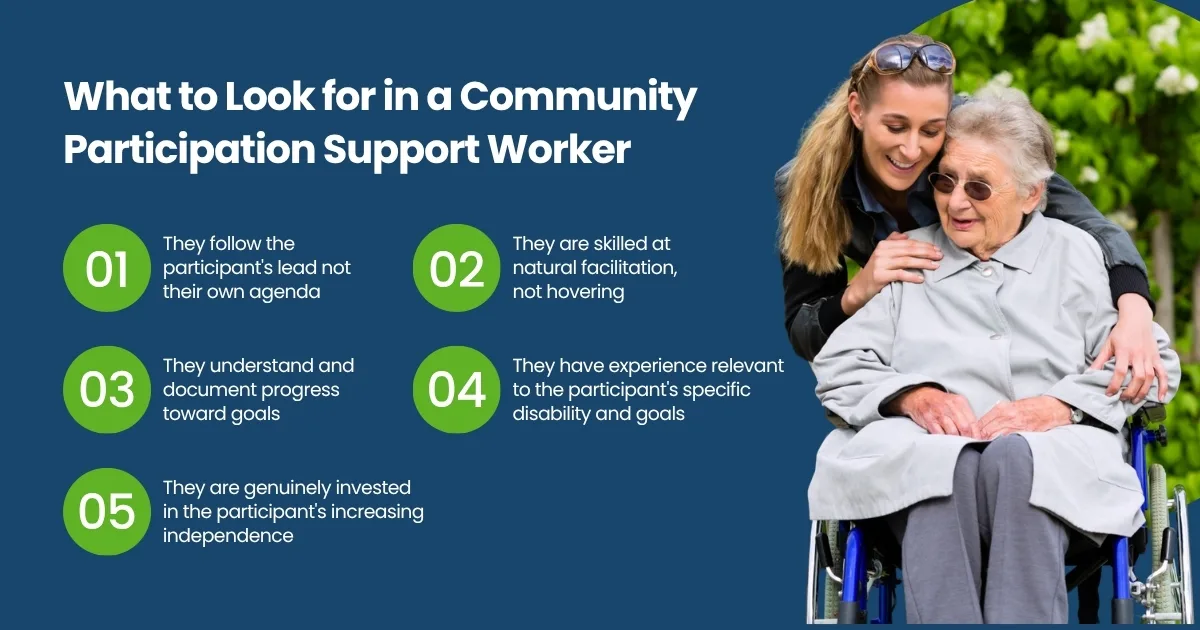
The quality of the support worker who accompanies and supports a participant in community settings has an enormous influence on whether community participation funding delivers real outcomes or simply fills time. Here is what distinguishes a high-quality community participation support worker:
- They follow the participant’s lead not their own agenda. The best community participation support workers understand that their role is to enable the participant’s goals, not to direct or manage the experience. They support choice and decision-making in real time, asking rather than assuming, and creating space for the participant to navigate situations with increasing independence rather than defaulting to assistance.
- They are skilled at natural facilitation, not hovering. In community settings, an overpresent or visually obvious support worker can inadvertently create a barrier to natural social interaction. Quality community participation workers know how to be present and available without dominating the interaction facilitating connection rather than interrupting it.
- They understand and document progress toward goals. Support workers should maintain clear records of what was attempted, what went well, what was challenging, and what the participant’s next steps are. This documentation is not just administrative it is the evidence base for plan reviews and the tool that allows the participant, their support coordinator, and their provider to track whether the community participation plan is working.
- They have experience relevant to the participant’s specific disability and goals. A support worker experienced in supporting participants with intellectual disabilities, psychosocial conditions, autism, or acquired brain injury will bring specific knowledge of how different disabilities affect community engagement and how to adapt support accordingly. This is not a generic skill; it matters that experience is relevant and specific.
- They are genuinely invested in the participant’s increasing independence. The goal of good community participation support is, ultimately, to make itself less necessary to build the participant’s confidence, skills, and community connections to the point where they need less support. A support worker who is genuinely committed to this direction will actively and consistently work to expand what the participant can do independently, rather than maintaining a level of support that serves the worker’s continuity rather than the participant’s growth.
How Royalty Healthcare Delivers Community Participation Support in Brisbane
Royalty Healthcare is a registered NDIS provider delivering NDIS Community Participation support across Brisbane, Ipswich, Logan, Gold Coast, and the Sunshine Coast. Their approach is built around the principle that community participation is not a scheduled activity it is a planned, progressive investment in the participant’s independence and quality of life.
Their support workers are selected for their ability to facilitate natural community engagement, matched carefully to each participant’s personality, interests, and specific goals, and supported by a management team that maintains ongoing oversight of goal progress. Every community participation plan is connected to the participant’s broader NDIS goals and reviewed regularly to ensure it continues to reflect what the participant actually wants.
Conclusion
Community participation funding is one of the NDIS’s most flexible and potentially transformative supports but only when it is used intentionally. Vague goals, poorly matched support workers, and activities chosen without reference to the participant’s actual aspirations produce poor outcomes and wasted funding. Specific goals, skilled and well-matched support, and a genuine commitment to progressive independence produce something entirely different: participants who are more connected, more confident, and more capable than when they started.
The ideas in this guide are a starting point, not a ceiling. Every participant’s community is different, every participant’s goals are different, and every participant’s path toward independence looks different. The most important step is the first one identifying what genuinely matters to you, and finding a provider committed to helping you get there.