
NDIS Mental Health Support: What Funding Covers and How to Access It
Mental health is a central part of overall wellbeing, and for many Australians living with a psychosocial disability, it is also one of the most complex areas to navigate under the NDIS. The scheme does fund mental health supports, but understanding what is covered, which budget category it falls under, and how to actually access it can be genuinely confusing without clear guidance.
This blog is designed to cut through that confusion. Whether you are a participant exploring your options for the first time, a carer supporting a loved one, or a support coordinator helping a client understand their plan, this guide explains what NDIS mental health funding covers, how eligibility works, and what to look for in a qualified provider.
What Is a Psychosocial Disability?
Before understanding how the NDIS funds mental health support, it helps to understand how the scheme classifies mental health conditions. The NDIS uses the term “psychosocial disability” to describe the functional impact of a mental health condition on a person’s daily life not simply the diagnosis itself.
A person living with conditions such as schizophrenia, bipolar disorder, severe depression, borderline personality disorder, PTSD, or anxiety disorders may experience significant limitations in their ability to carry out daily activities, maintain relationships, manage their home, or participate in the community. It is this functional impact, not the diagnosis alone, that the NDIS assesses when determining eligibility and funding.
This distinction is important: two people with the same mental health diagnosis may receive very different NDIS outcomes depending on how their condition affects their day-to-day functioning and what supports they need to achieve their goals.
What NDIS Mental Health Funding Actually Covers
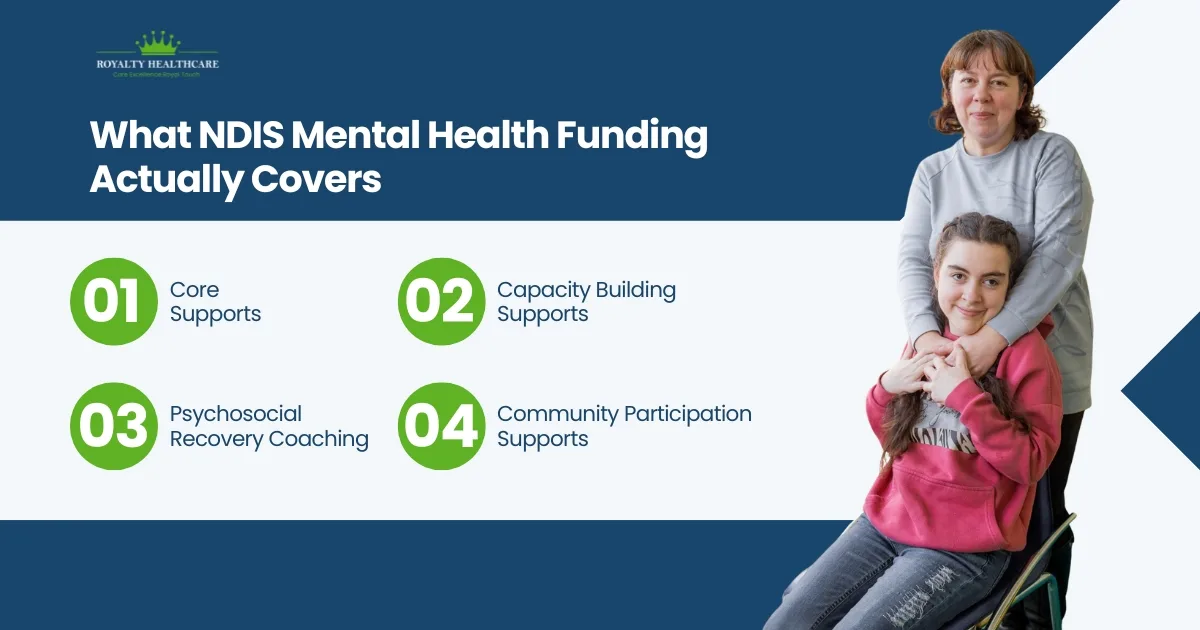
NDIS mental health funding is not a single line item; it draws from across multiple support categories, depending on the type of support required. Understanding these categories helps participants and their representatives make the most of their plan.
Core Supports fund assistance with daily living tasks that a participant may struggle with due to their psychosocial disability. This includes help with personal care, household tasks, meal preparation, and medication management. Core supports are the most flexible budget category and can be used across a range of providers.
Capacity Building Supports fund activities designed to build skills, resilience, and independence over time. For mental health participants, this commonly includes support from mental health practitioners, psychosocial recovery coaches, and skill-building programs focused on communication, emotional regulation, and daily living skills.
Psychosocial Recovery Coaching is one of the most significant supports available to mental health participants specifically. A recovery coach works alongside the participant to help them understand and use their NDIS plan, build connections with health and community services, and work toward their individual recovery goals. Recovery coaching is distinct from Support Coordination and sits within the Capacity Building budget.
Community Participation Supports fund assistance for participants to engage in social, recreational, and community activities an important component of mental health recovery and long-term wellbeing. Maintaining community connection is a recognised protective factor for people living with psychosocial disability.
It is important to note that the NDIS does not fund clinical mental health treatment such as psychiatry, psychology under Medicare, or inpatient services. These are funded through the health system. NDIS funding focuses on the non-clinical supports that help participants build their capacity, manage daily life, and work toward their goals.
Signs That You or Your Loved One May Be Eligible for NDIS Mental Health Funding
Many people living with mental health conditions are not aware they may qualify for NDIS support. Eligibility is determined by functional impact how the condition affects daily life rather than diagnosis alone. Here are the key indicators that it may be worth applying:
- Difficulty managing daily tasks independently. If a mental health condition regularly affects your ability to cook, clean, manage medications, maintain your home, or carry out personal care without assistance, this is a core eligibility signal the NDIA considers.
- Significant impact on social and community participation. Persistent withdrawal from social activities, difficulty maintaining relationships, or an inability to engage in community life due to mental health symptoms can support an NDIS application.
- Ongoing need for professional support or coaching. If you regularly require the support of a mental health professional, psychosocial recovery coach, or disability support worker to manage your day-to-day life, this reflects the kind of functional impairment the NDIS is designed to address.
- The condition is permanent or likely to be permanent. The NDIS requires that the disability is permanent or likely to be permanent. For many people with severe or treatment-resistant mental health conditions, evidence from a treating psychiatrist or psychologist can support this requirement.
- You are aged between 7 and 65. NDIS eligibility requires that you are an Australian citizen or permanent resident aged between 7 and 65 at the time of application.
If you are unsure whether you or your loved one may qualify, reaching out to a registered NDIS provider or Local Area Coordinator (LAC) for a conversation is always a worthwhile first step. You can also check eligibility directly on the NDIS official website.
How to Access NDIS Mental Health Support Step by Step
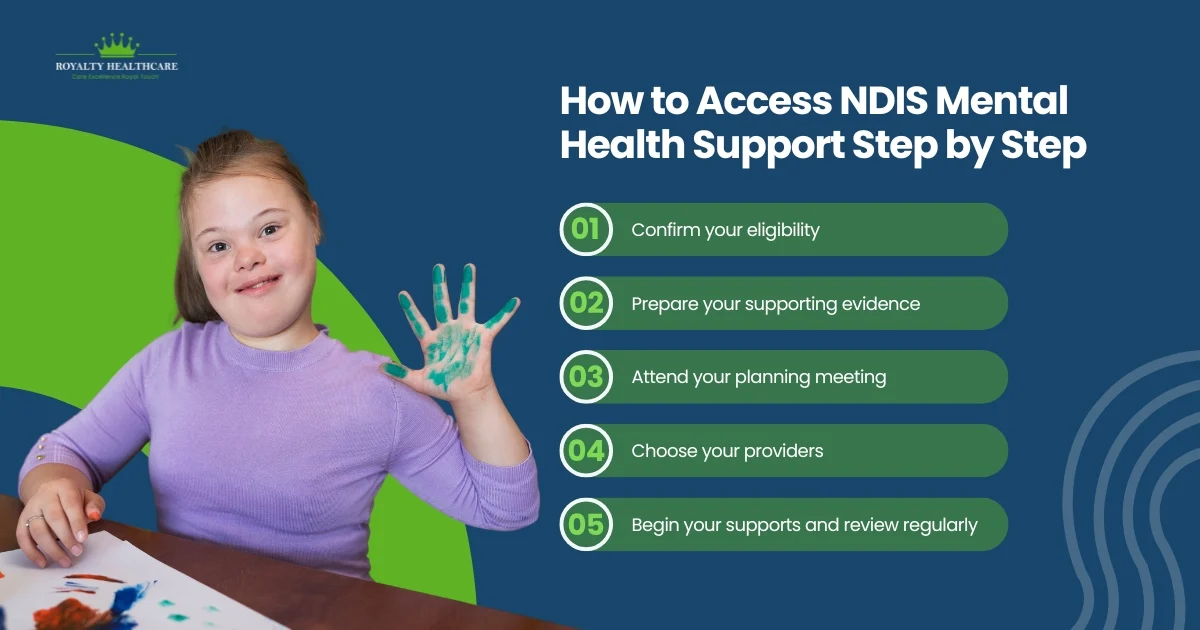
Knowing you need support and knowing how to access it are two different things. Here is a clear, step-by-step overview of the process.
- Step 1 — Confirm your eligibility. Contact the NDIS on 1800 800 110 or visit ndis.gov.au to submit an Access Request. You will need supporting evidence from a treating health professional typically a psychiatrist, GP, or clinical psychologist — that documents your diagnosis, its functional impact, and its likely permanence.
- Step 2 — Prepare your supporting evidence. Strong evidence is the foundation of a successful NDIS application for mental health. This means detailed reports that describe how the condition affects your daily functioning across multiple life areas not just a letter confirming the diagnosis. Allied health assessments, occupational therapy reports, and psychosocial functional assessments all strengthen an application.
- Step 3 — Attend your planning meeting. Once your access is approved, you will have a planning meeting with an NDIA planner or Local Area Coordinator. This is the conversation where your goals, support needs, and funding levels are determined. Preparing a clear written list of your daily support needs, recovery goals, and the types of supports you are seeking before this meeting will significantly improve your outcome.
- Step 4 — Choose your providers. Once your plan is approved, you choose the registered providers who will deliver your supports. You are not locked in NDIS participants have the right to change providers at any time, subject to notice periods in service agreements.
- Step 5 — Begin your supports and review regularly. Your NDIS plan is reviewed annually. Keeping records of how your supports are working and communicating clearly with your provider about your progress helps ensure your next plan review reflects your actual needs.
How Royalty Healthcare Supports NDIS Mental Health Participants
Royalty Healthcare is a registered NDIS provider delivering trauma-informed mental health support across Brisbane, Ipswich, Logan, Gold Coast, and the Sunshine Coast. Their NDIS Mental Health Support service is built around each participant’s individual recovery goals not a generic program.
Their approach is person-centred and culturally sensitive, with support designed to build genuine capacity and resilience over time. The team works collaboratively with participants, families, support coordinators, and allied health professionals to ensure every aspect of the participant’s support plan is aligned and effective.
Conclusion
NDIS mental health funding has the potential to transform the lives of Australians living with psychosocial disability but only when participants understand what is available, how to access it, and who to trust with their support.
The process from application to active supports takes time and preparation. Strong evidence, a clear understanding of your goals, and a provider who takes a genuine person-centred approach make an enormous difference to the outcome.
If you are ready to explore what NDIS mental health support looks like in practice, contact Royalty Healthcare today. Our team across Queensland is here to guide you through every step from your first question to your first session.