



How to Use Your NDIS Funds Wisely and Get the Support You Really Need
Opening your first NDIS plan can feel overwhelming. You see a total dollar figure, a set of unfamiliar category names, and a long list of rules about what you can and can’t spend money on. For many participants and families, the hardest part isn’t qualifying for the scheme; it’s understanding how to actually use the funding once it arrives.
Getting this right matters. When you understand how your NDIS Funds are structured, you make better decisions, avoid running out of budget too early, and direct your money towards the supports that genuinely improve your life. When you don’t, funding often goes underused, gets spent on the wrong things, or simply expires unused at the end of the plan period.
This guide breaks down how NDIS Funds work, how to spend them strategically, and how to make sure your plan reflects the support you really need. It’s written from the perspective of a registered NDIS provider that works with participants across South-East Queensland every day.
Understanding How Your NDIS Funds Are Structured
Before you can spend wisely, you need to understand the “buckets” your money sits in. Your NDIS plan doesn’t give you one flexible pot of cash. Instead, it divides funding into separate categories, each with its own rules about what it can be used for.
Most participants’ funding falls under three main budgets: Core Supports, Capacity Building and Capital Supports. Newer plans on the NDIS PACE system may also include a fourth type for recurring supports. Think of these as different bank accounts: in most cases, you can’t freely move money from one to another.
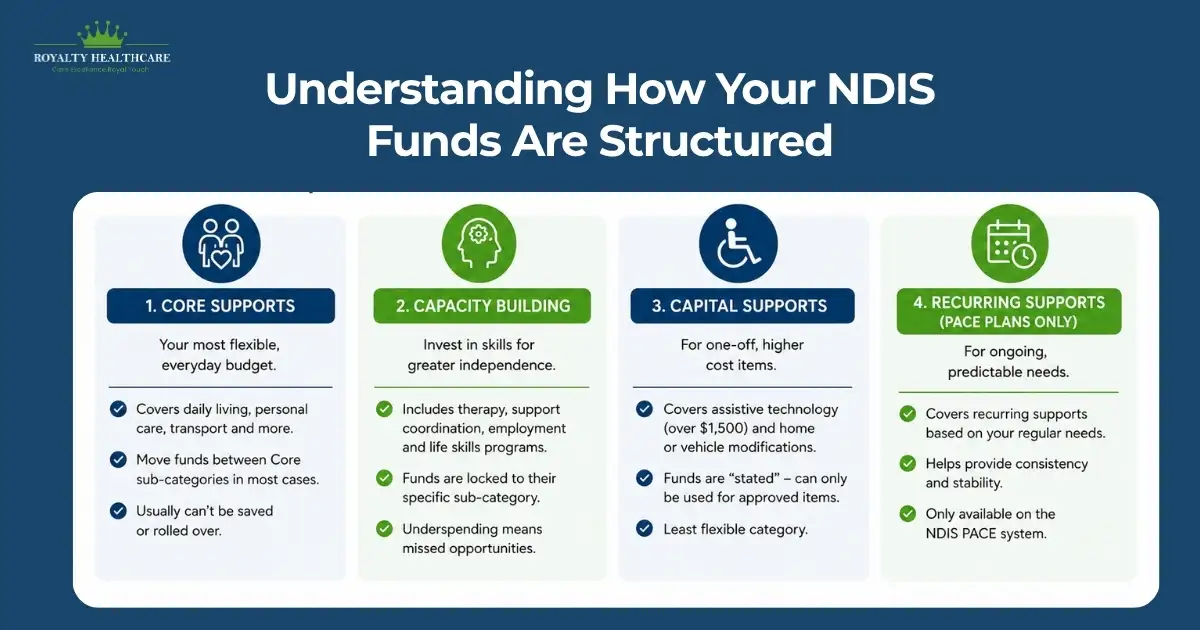
Here’s how each one works, with the key points you need to know:
1. Core Supports:
This is usually the largest part of a plan and covers day-to-day assistance: help with personal care, daily living tasks, community participation, transport, and consumables like continence products. The big advantage of Core is flexibility. In most cases, you can move funds between Core sub-categories to respond to changing needs, for example, using unspent social participation funding for extra daily living support. Transport is the common exception, as it can have its own limits. One important rule: Core budget generally can’t be saved or rolled over. If you don’t use it within your plan period, you lose it.
2. Capacity Building:
This funding is designed to build your skills, so you rely on less support over time. It pays for things like therapy (occupational therapy, physiotherapy, speech pathology), support coordination, employment support, and programs that develop daily living or life skills. Unlike Core, Capacity Building is far less flexible. Funds are locked to their specific sub-category; money allocated for therapy can’t be redirected to something else. This makes planning important, because underspending here often means missing out on skill-building you were entitled to.
3. Capital Supports:
This budget covers assistive technology (usually items over $1,500 such as wheelchairs or communication devices) and home or vehicle modifications like bathroom rails or ramps. Capital Supports are the least flexible of all. These funds are “stated,” meaning they can only be spent on the specific item they were approved for. You can’t repurpose leftover Capital funding for daily supports.
4. Recurring Supports:
Some newer plans include funding for ongoing, predictable needs. If your plan is on the NDIS’s newer computer system, you may see a fourth category here, so it’s worth checking exactly how yours is set out.
The single most useful habit is to know which category each of your supports comes from, and how flexible that category is. A quick call to your support coordinator or plan manager to walk through your specific plan is one of the best investments of time you can make early on. If you’re still comparing providers, our guide on how to choose the right registered NDIS provider is a helpful starting point.
How to Spend Your NDIS Funds Wisely: A Practical Approach
Understanding the categories is step one. Spending strategically is where participants get real value from their plan. The goal isn’t simply to use up every dollar; it’s to direct funding towards supports that move you closer to your goals while making sure essential day-to-day needs are always covered.
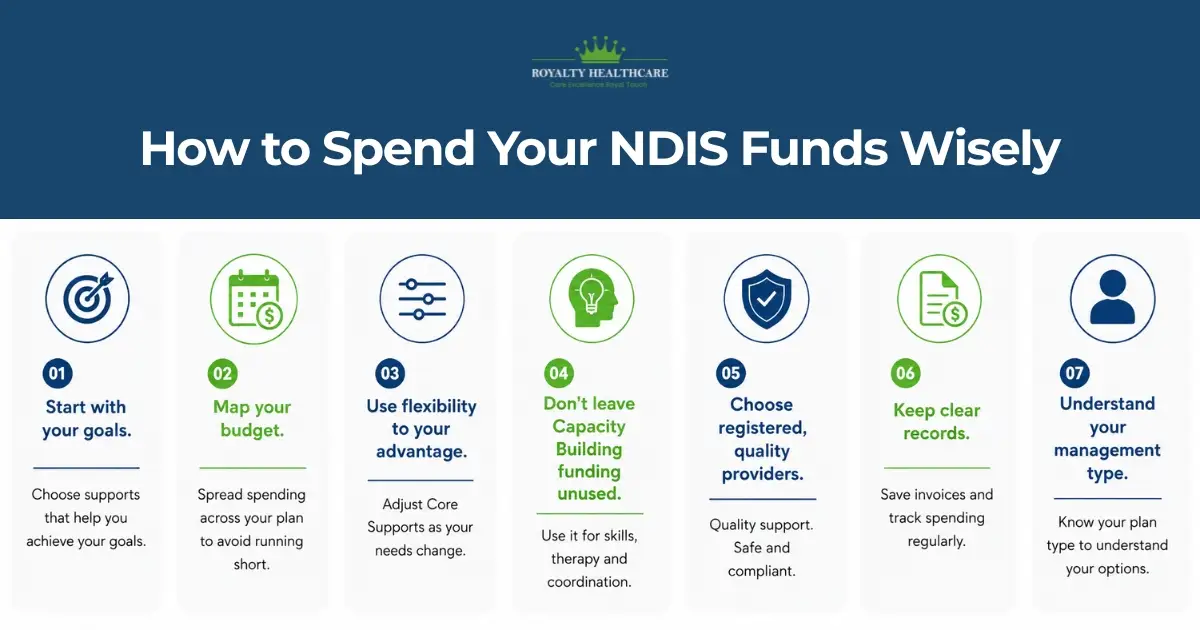
Here are the practical principles that help participants get the most from their NDIS Funds:
1. Start with your goals, not the price list
Your NDIS plan is built around goals: living more independently, participating in your community, improving your health, or working towards employment. Before booking any service, ask whether it genuinely supports one of those goals. Funding used with purpose delivers far more value than funding spent reactively or out of habit.
2. Map your budget across the whole plan period
One of the most common mistakes is spending too quickly and running short before the plan ends. Take your Core budget, divide it roughly across the number of weeks or months in your plan, and use that as a guide. This “budget pacing” approach helps you avoid the stressful situation of having essential supports but no funding left to pay for them.
3. Use flexibility to your advantage
Because Core Supports are largely flexible, you can adjust spending as your life changes. If you need more help around the home one month and less community access, you can shift accordingly. Knowing where you have flexibility (Core) and where you don’t (Capacity Building and Capital) lets you plan with confidence.
4. Don’t leave Capacity Building funding on the table
Because this budget is locked and can’t be moved, it’s frequently underspent. Yet it funds exactly the supports that reduce your need for help: long-term therapy, skill development, and support coordination. If you have Capacity Building funding you haven’t touched, that’s usually a sign to review your plan and put it to work.
5. Choose registered, quality providers
The provider you choose affects both the quality of support and how smoothly your funding is used. Registered NDIS providers are approved by the NDIS Quality and Safeguards Commission, follow the NDIS Practice Standards, and must complete staff screening and regular audits. This matters most if your plan is NDIA-managed, where you’re generally required to use registered providers. You can explore the full range of NDIS support services we deliver to see how services map to your budget.
6. Keep clear records and track your spending
Save your service agreements, invoices, and receipts, and keep an eye on your remaining balance through the myplace participant portal or your plan manager. Good records make plan reviews far easier and help you demonstrate what’s working.
7. Understand your management type.
How your plan is managed self-managed, plan-managed, or NDIA-managed affects your flexibility. Self-managed and plan-managed participants can often use a wider range of providers, while NDIA-managed plans are limited to registered providers. Knowing your type helps you plan realistically.
The right combination of pacing, purpose, and provider choice turns a confusing plan into a genuinely useful one. If you’re setting up supports after a hospital stay, a coordinated intake process can also help you get services in place quickly without wasting funding on delays.
Common Mistakes That Waste NDIS Funds
Even well-intentioned participants lose value through avoidable errors. Being aware of these helps you sidestep them:
Spending too fast early in the plan, then running short later, is the most frequent issue pacing prevents. Letting Capacity Building or Capital funding expire unused is another, since those funds can’t be rolled over or redirected. Some participants also try to move money between categories that don’t allow it, only to find the request rejected. And a surprising number simply don’t book supports they’re entitled to because the paperwork feels intimidating. A good provider or support coordinator can remove most of that friction.
Making Sure Your Plan Reflects the Support You Really Need
Sometimes the problem isn’t how you’re spending it’s that the plan itself doesn’t match your current needs. Life changes, and your funding should keep pace.
If your circumstances shift a change in your health, living situation, or support needs you can request a plan review or a change to your plan. Keeping notes on how your supports are working, and where the gaps are, gives you strong evidence to bring to that conversation. The clearer you are about what’s helping and what isn’t, the more likely your next plan will reflect the reality of your day-to-day life.
This is also where a knowledgeable provider adds real value. When your support team understands your goals, they can flag when your funding no longer fits your needs and help you prepare for a review. For deeper information straight from the source, the official NDIS website sets out the rules on plan budgets, categories, and requesting changes.
Get Support From a Provider That Puts You First
Understanding your NDIS Funds is the foundation, but you don’t have to navigate it alone. The right registered provider helps you interpret your plan, use each budget category correctly, and direct your funding towards the supports that genuinely improve your life.
Royalty Healthcare is a registered NDIS provider delivering person-centred support across Brisbane, Ipswich, Logan, Gold Coast and the Sunshine Coast. From daily living assistance and community participation to supported accommodation and nursing care, our team helps participants make the most of every dollar in their plan with respect, transparency, and a genuine commitment to your independence.



1 Comment
How NDIS Plan Management Gives You More Choice and Flexibility
August 24, 2026[…] NDIS funding yourself means tracking budgets, checking invoices, submitting claims, and keeping audit-ready […]