

What Families Should Know About Complex Disability Care on the Gold Coast
When someone you love needs help with breathing, eating, seizures, or behaviours that put them at risk, disability care stops being an abstract idea. It becomes a daily, hands-on reality. Families often find themselves learning clinical language, coordinating nurses and support workers, and negotiating funding all at once, usually while still providing a large share of the care themselves.
The Gold Coast is home to more than 17,000 active NDIS participants, and the local disability sector is large and growing. That brings choice, but it also brings confusion. Not every organisation that advertises complex care is trained, equipped, or registered to deliver it, and for families the difference is significant.
This guide explains what complex care means under the National Disability Insurance Scheme, how funding for high-level needs works, and what to check before trusting anyone with the care of a family member. It is written for parents, partners, siblings and adult children: anyone who helps make decisions about care.
Understanding what high-level disability support involves
Under the NDIS, complex care generally refers to supports that carry a higher level of clinical risk and require workers with specific training and supervision. The NDIS Quality and Safeguards Commission groups many of these under the term “high intensity daily personal activities”. They include complex bowel care, enteral (tube) feeding, tracheostomy management, urinary catheter management, ventilation support, subcutaneous injections, complex wound care, severe swallowing difficulties (dysphagia), and epilepsy and seizure management.
Complex care is not only physical. Some people live with behaviours of concern, co-occurring mental health conditions, or several disabilities that interact in ways that make everyday routines harder to manage safely.
The key point for families is that NDIS complex care is defined by the support a person needs, not by their diagnosis. Two people with the same condition may need entirely different levels of help. A detailed description of daily life, including the hard days, matters far more than a medical label. For a closer look at each of these supports, see our family guide to high-intensity supports under the NDIS.
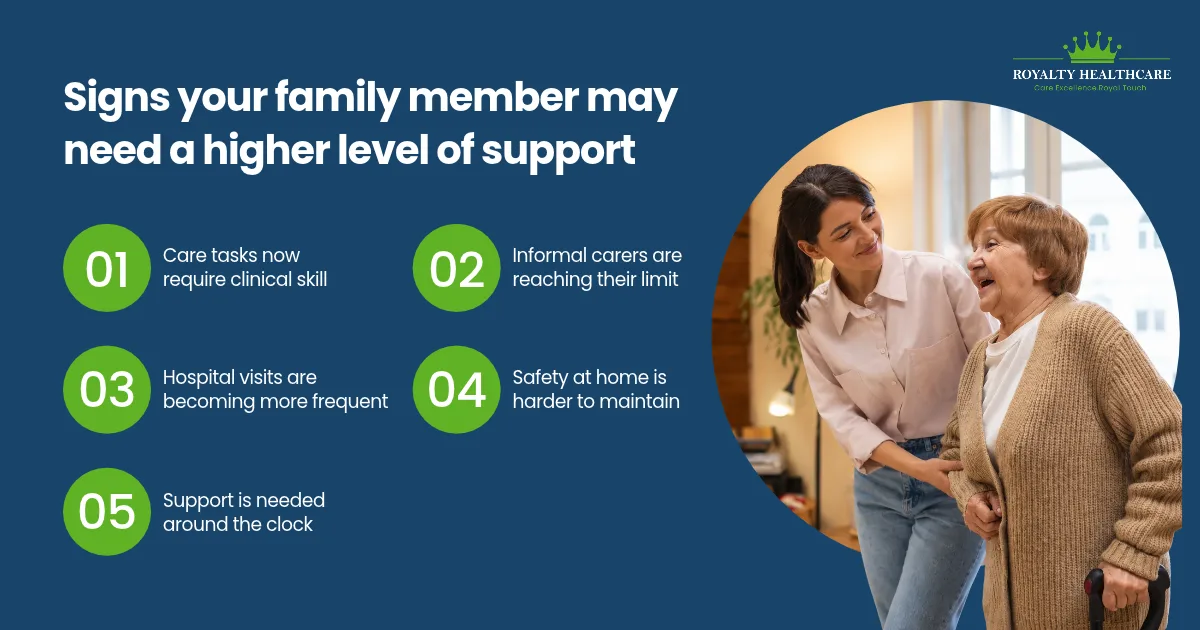
Signs your family member may need a higher level of support
Needs rarely change overnight. Families often adapt gradually until the load becomes unsustainable. These signals suggest it is time to review the level of care.
1. Care tasks now require clinical skill.
If daily care involves managing a feeding tube, suctioning a tracheostomy, giving medication through a PEG, or responding to prolonged seizures, those tasks need trained workers with documented competency. Families can and do learn these skills, but relying on untrained helpers, or a single family member, creates real risk. Our guide to NDIS community nursing explains when nursing support can be funded.
2. Informal carers are reaching their limit
Exhaustion, broken sleep, reduced work hours and declining health in a parent or partner are not personal failings. They are evidence. The NDIS is required to consider what families can reasonably be expected to provide, and carer strain is a legitimate part of that conversation.
3. Hospital visits are becoming more frequent
Repeated emergency presentations for aspiration, infections, falls or unmanaged seizures often point to gaps in day-to-day support. Better-trained support at home can reduce avoidable admissions, and hospital records help demonstrate the need.
4. Safety at home is harder to maintain
Wandering, self-injury, risk to others, choking episodes or unsafe transfers all indicate that the current arrangement may no longer be adequate. Documenting incidents, including dates and what happened, strengthens any request for additional support.
5. Support is needed around the clock
When a person needs overnight monitoring, repositioning for pressure care, or two workers for safe transfers, the level of support has moved well beyond occasional help. This is often the point where shared living or intensive in-home arrangements come into consideration.
How NDIS funding works for high-level needs
Every support in an NDIS plan must be “reasonable and necessary”. In practice, that means it must relate to the person’s disability, help them pursue their goals, represent value for money, be likely to be effective, take informal supports into account, and be the NDIS’s responsibility rather than another system’s.
For complex needs, funding usually draws on several areas. Core supports cover daily personal care and assistance, including higher-intensity care delivered by trained workers. Capacity building supports fund therapy, nursing assessments and training for workers and family. For people who need significant help in a shared home, Supported Independent Living funds the support provided within the home, while Specialist Disability Accommodation may fund the dwelling itself for eligible participants with extreme functional impairment or very high support needs.
It is also important to understand where the NDIS stops and the health system starts. Acute medical treatment, hospital care and clinical treatment of health conditions remain the responsibility of the health system, including public hospitals on the Gold Coast. The NDIS funds disability-related health supports that relate to a person’s functional impairment and are part of their daily life, such as ongoing catheter care or meal-time support for dysphagia.
Strong evidence makes the difference. Reports from treating professionals should describe what the person can and cannot do, how often they need help, who currently provides it and what happens when support is not available. Current information about planning and evidence is published on the NDIS website.
Choosing the right provider: questions worth asking
The right provider is not simply the one with availability this week. For complex care, a poor match can have serious consequences, so these questions are worth asking.
a. Are they registered for the supports you need?
Providers delivering high intensity daily personal activities as registered providers are audited against additional quality indicators set by the NDIS Commission. Ask which supports they are registered for, and check the NDIS Provider Register on the Commission’s website rather than relying on marketing claims.
b. Who trains the workers, and who oversees them?
Ask whether a registered nurse or appropriately qualified clinician develops care plans, trains staff, and signs off on competency for each participant. Generic training is not enough. Workers should be trained in your family member’s specific routines, equipment and emergency responses.
c. How is the roster built, and what happens when someone is sick?
Continuity matters enormously in complex care. Ask how many regular workers will support your family member, how new staff are introduced, and what the backup plan is when a worker cancels at short notice.
d. How do they manage incidents and complaints?
Registered providers must report certain serious incidents to the NDIS Commission and have a clear complaints process. A provider who explains this openly and treats feedback as useful rather than threatening is usually a safer choice.
e. Will they plan with your family, not just for you?
Good providers value family knowledge. They involve the participant and their family in care planning, record preferences in the person’s own words and review plans when needs change. Among the many NDIS providers Gold Coast families can choose from, this collaborative approach is often what separates adequate care from excellent care.
f. Can they work alongside hospitals and specialists?
Complex care rarely sits with one organisation. Ask how the provider communicates with GPs, specialists, allied health professionals and hospital discharge teams, and who takes responsibility for coordinating that information.
Local considerations families often overlook
The Gold Coast stretches from the northern growth corridor around Coomera and Pimpama to the southern beaches and the hinterland. Travel distance affects worker availability, so a provider with staff based near your area may offer more reliable rostering and fewer late cancellations. When comparing disability support services, Gold Coast families should ask directly which suburbs a provider regularly covers.
Hospital transitions deserve early attention. If your family member is currently in hospital, speak with the treating team and social worker about discharge planning as soon as possible. Equipment and trained workers take time to arrange, and starting early reduces the risk of a delayed or unsafe discharge.
Accessible housing is another pressure point. Specialist Disability Accommodation and suitable shared homes may have waitlists, so it helps to explore options well before a move becomes urgent. Families living near the Queensland and New South Wales border should also confirm that any provider can deliver support where the person actually lives and spends time.
Looking after the people who care
Families are often the most constant part of a person’s support network, and that role deserves protection. Short Term Accommodation and in-home respite can be funded through the NDIS where they are reasonable and necessary, giving carers time to rest while their loved one continues to receive appropriate support.
Carers can also access free support in their own right through Carer Gateway, a national service that offers counselling, coaching, peer support and emergency respite. Using these services is part of making care sustainable over the long term.
It also helps to write down what you know. Daily routines, early warning signs, communication preferences and what works during a crisis are invaluable to new workers. This kind of practical record strengthens complex care Gold Coast arrangements because it keeps the person’s needs central, even as staff change.
Moving forward with confidence
Complex disability care can feel overwhelming at first, but families do not have to navigate it alone. Understanding what complex care involves, how funding decisions are made and what a capable provider looks like puts you in a far stronger position to advocate for the person you care about.
Start with clear evidence, ask direct questions and choose providers who are transparent about their registration, training and processes. Above all, keep your loved one’s goals at the centre of every decision. The right support should not only keep someone safe; it should help them live the life they want.
Royalty Healthcare is a registered NDIS provider based in Strathpine, supporting participants and families across Brisbane, Ipswich, Logan, the Gold Coast and the Sunshine Coast. Our registered nurses, behaviour support practitioners and trained support workers deliver complex care as one team, at home, in supported accommodation and during short-term stays. If you are weighing up options for a family member, our team is happy to talk through what the plan currently funds and what support might fit.