
The Real Difference Between SIL and STA (And Why It Matters for Your Plan)
If you have spent any time navigating the NDIS, you will have come across the terms SIL and STA. Both sit under the broader umbrella of NDIS supported accommodation. Both appear in similar conversations about where a participant lives, how they are supported, and what their plan covers. And both are frequently confused, conflated, or misunderstood in ways that can have real consequences for how a participant’s plan is structured and funded.
This confusion is understandable. The NDIS uses a lot of acronyms, and the distinction between these two support types is not always explained clearly during planning meetings. But SIL and STA are fundamentally different in purpose, funding structure, eligibility requirements, and what they look like in everyday life and getting that distinction right matters enormously when it comes to ensuring your plan reflects what you actually need.
This guide explains both support types clearly, breaks down the key differences, and helps participants, families, and support coordinators understand when each one applies and why it matters so much to get it right.
What Is Supported Independent Living (SIL)?
Supported Independent Living is one of the NDIS’s most significant and widely accessed supports for participants who require consistent, ongoing assistance with daily tasks in order to live as independently as possible.
SIL funding covers the support workers who assist a participant day to day not the physical home itself. A participant living in an SIL arrangement might share a home with other participants, or in some cases live alone, with support workers present across shifts to assist with personal care, meal preparation, medication management, household tasks, and community access.
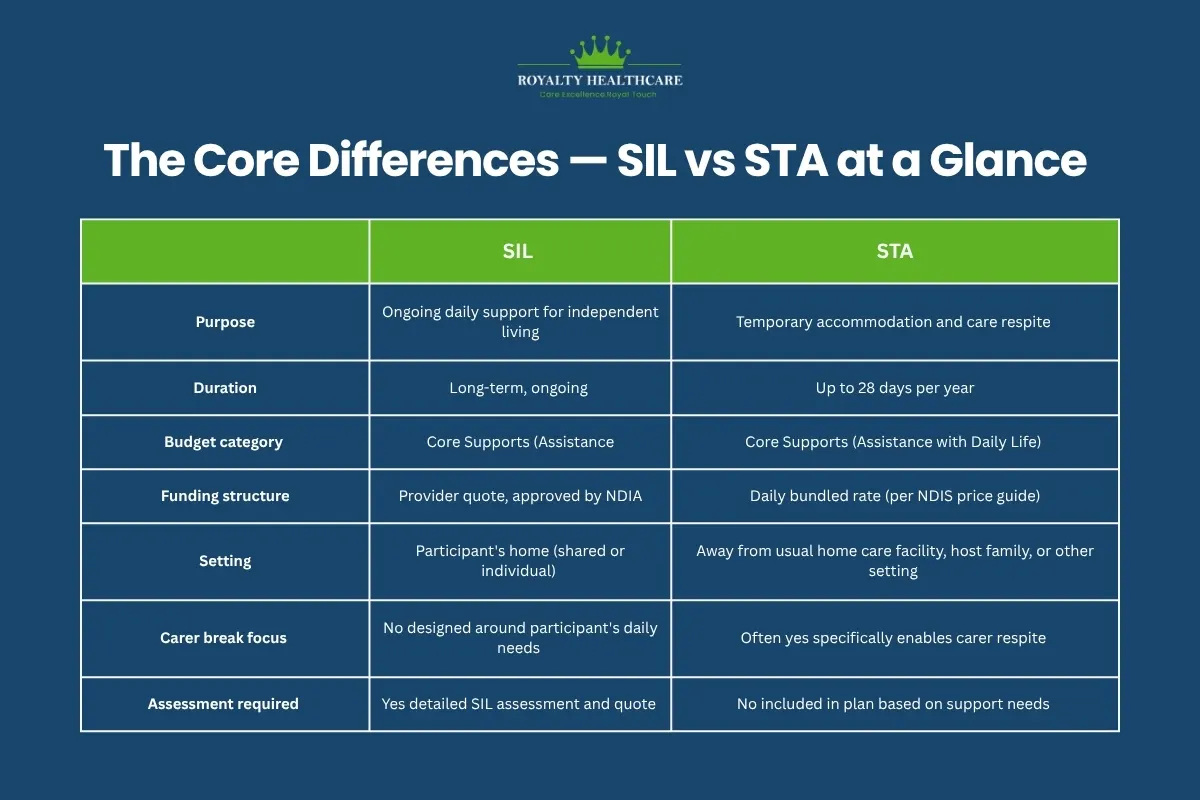
SIL is designed for the long term. It is ongoing, recurrent funding that reflects a participant’s stable, ongoing support needs. It is not time-limited or tied to a specific event or recovery period. For participants with intellectual disabilities, physical disabilities, psychosocial conditions, or complex and high-intensity care needs, SIL is often the primary funded support that makes living outside a residential care setting possible.
Because SIL involves significant ongoing funding, the NDIS requires a detailed quote from a registered SIL provider, assessed against the participant’s individual support needs, before it can be included in a plan. The process involves functional assessments, an SIL Assessment Tool, and in many cases input from allied health professionals and support coordinators.
It is also important to understand that SIL is separate from Specialist Disability Accommodation (SDA). SDA is the capital funding that covers the physical home itself the building, its accessibility features, and its location. SIL is the support funding. A participant can receive SIL without SDA (for example, in a privately rented home or a family property), and in some cases vice versa. Knowing this distinction is essential to understanding how to structure an accommodation plan holistically. You can learn more about how SDA and SIL interact on the official NDIS website.
What Is Short-Term Accommodation (STA)?
Short-Term Accommodation is exactly what its name suggests a temporary, time-limited funded support that covers accommodation and care for a participant away from their usual home environment for a short period. It is commonly referred to as respite care, though the two terms are not perfectly interchangeable under the NDIS.
STA is funded under the Core Supports budget, specifically under the Assistance with Daily Life category. It covers the cost of accommodation, personal care, food, and activities during the stay as a single, bundled rate per day. The NDIS price guide sets the maximum daily rate for STA, and the funding is inclusive rather than itemised.
The NDIS currently allows participants to access up to 28 days of STA per year in their plan, though additional days can be requested in some circumstances with appropriate justification. STA can be used in a single block or broken into smaller periods across the year, depending on the participant’s needs and circumstances.
STA serves two primary purposes. First, it provides a break for informal carers family members or partners who provide the majority of day-to-day support to a participant and who need a period of rest, recovery, or time to manage personal commitments. Second, it provides the participant themselves with a change of environment, new social opportunities, and in some cases a trial experience of a new living arrangement before committing to a longer-term option.
The Core Differences — SIL vs STA at a Glance
When SIL Is the Right Choice for Your Plan
SIL is not appropriate for every NDIS participant, and including it in a plan that does not genuinely call for it or failing to include it in a plan that does can have serious consequences. Here are the circumstances in which SIL is the right choice:
- You need consistent, ongoing support with daily tasks. Personal care, meals, medications, and household tasks on a sustained, regular basis SIL funds the workers who make that possible safely every day.
- You want to live in the community, not in a care facility. SIL exists specifically to make home-based living achievable for participants whose support needs would otherwise require an institutional setting.
- You are transitioning from the family home or another arrangement. Life changes leaving home for the first time, moving out of a care facility, or adjusting after a health change are the most common triggers for a SIL application.
- Your assessed needs span multiple daily shifts. If your functional assessment indicates support is needed across mornings, afternoons, and overnight, SIL is the funding mechanism designed to cover that shift-based presence.
- You are moving into a shared living arrangement with other participants. Shared SIL homes are common, cost-effective, and often socially enriching particularly for participants stepping into supported living for the first time.
When STA Is the Right Choice for Your Plan
STA is sometimes treated as a secondary concern in NDIS planning an add-on that families think about after the more prominent supports are sorted. In practice, STA plays a genuinely important role in the sustainability of care arrangements, and getting it included in your plan at the right level deserves careful attention.
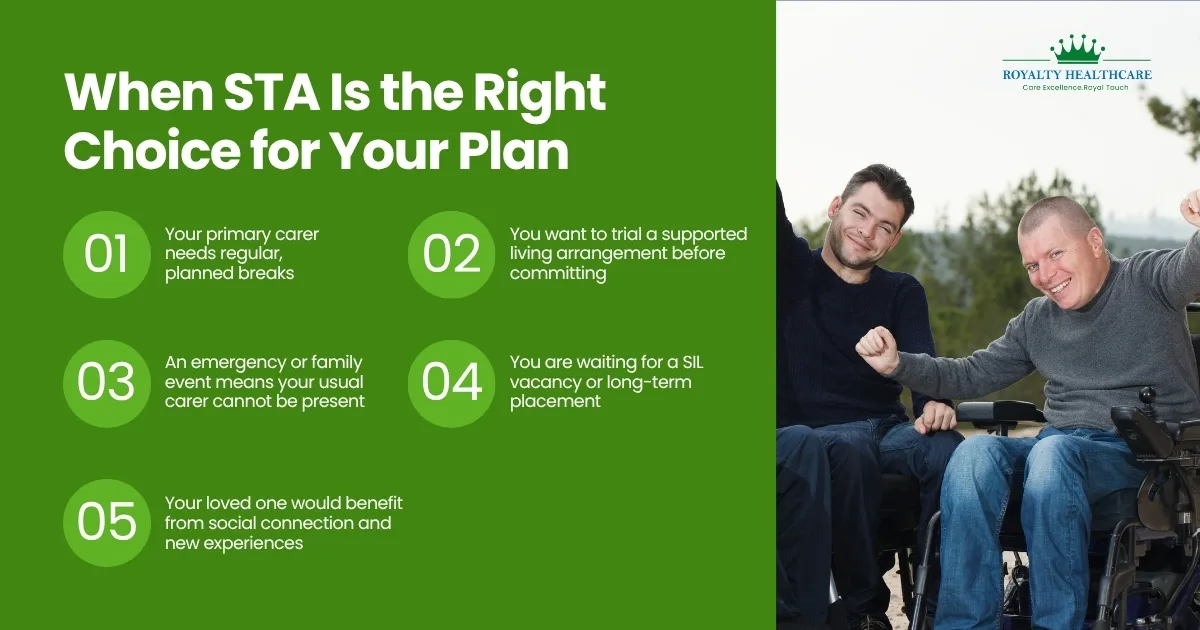
- Your primary carer needs regular, planned breaks. STA funds temporary care in an alternative setting, giving family carers the rest they need to remain healthy and sustainable in their caregiving role long term.
- You want to trial a supported living arrangement before committing. A short STA stay at a prospective SIL provider’s home gives participants and families real, lived experience of a setting before making any long-term decision.
- An emergency or family event means your usual carer cannot be present. Medical procedures, bereavements, or unavoidable commitments happen. STA provides a funded, planned solution so care continuity is never compromised.
- You are waiting for a SIL vacancy or long-term placement. STA bridges the gap providing appropriate care and accommodation during what can otherwise be a stressful and uncertain waiting period.
- Your loved one would benefit from social connection and new experiences. A change of environment, structured activities, and new social opportunities have genuine wellbeing benefits particularly for participants with limited regular community access.
Why Getting This Right Matters for Your NDIS Plan
The practical consequences of confusing SIL and STA or of having the wrong one in your plan are significant.
If STA is included in a plan when SIL is what the participant actually needs, the participant will receive time-limited respite funding that does not address their day-to-day support needs. They will not have the ongoing funded support required to live safely and independently. This is one of the most common planning gaps that support coordinators encounter and it is one that can be avoided with the right preparation and evidence at the planning meeting.
Conversely, if a family is seeking STA for carer respite but the plan is structured around SIL alone, the primary carer has no funded pathway to access breaks placing the entire caregiving arrangement at risk over time.
The solution is ensuring that both supports are considered at every NDIS planning meeting not treated as mutually exclusive alternatives, but as potentially complementary elements of a well-rounded plan.
How Royalty Healthcare Supports Participants Across Both
Royalty Healthcare is a registered NDIS provider delivering supported accommodation services including both SIL and STA across Brisbane, Ipswich, Logan, Gold Coast, and the Sunshine Coast.
Their team understands that SIL and STA are not just funding categories they are real decisions that shape where participants live, how their days unfold, and how sustainable their care arrangements are over time. Royalty Healthcare works closely with participants, families, support coordinators, and plan managers to ensure the right supports are in place and that every element of the accommodation plan reflects the participant’s goals and needs.
Conclusion
SIL and STA are two of the most important and most misunderstood supports available to NDIS participants who need accommodation assistance. Understanding the difference between them is not just an academic exercise. It directly shapes the plan you receive, the support you can access, and the quality of life available to you or the person you care for.
SIL is about building a sustainable, ongoing supported living arrangement. STA is about providing temporary care, enabling carer respite, and creating flexibility within a broader support ecosystem. Both have a vital role to play and the best NDIS plans consider both thoughtfully, with evidence, clear goals, and the guidance of experienced professionals.
If you are preparing for a planning meeting, reviewing an existing plan, or simply trying to understand your options, contact Royalty Healthcare today. Our team across Queensland is here to help you get it right.