

Preparing for Your NDIS Plan Review or Reassessment
Your life doesn’t stay the same from one year to the next, and neither do your disability support needs. Perhaps you’ve become more independent with certain activities, started relying on additional assistance, or discovered that some supports aren’t working as expected.
Your NDIS plan should reflect these changes.
Preparing for an NDIS plan review or reassessment gives you an opportunity to explain what everyday life looks like now, what has changed, and what support you may need moving forward.
But where should you begin? What documents matter, and how can you make sure your concerns are understood?
Here’s a practical guide to approaching the process with greater confidence.
Understanding NDIS Plan Reviews and Reassessments
People often use the term “NDIS plan review” to describe any discussion about changing their funding or supports. However, the National Disability Insurance Agency (NDIA) distinguishes between different processes.
- Plan reassessment: This involves reconsidering your support needs when significant changes mean your existing plan may no longer be suitable. It can result in a new plan.
- Plan variation: A smaller adjustment to your existing plan, potentially addressing an urgent, temporary or minor change without requiring a full reassessment.
- Review of a decision: A separate process used when you disagree with certain decisions made by the NDIA.
Understanding these differences matters because not every change requires a completely new plan.
For example, someone who has recently moved into a different living arrangement and needs substantially different ongoing assistance may require a reassessment. A smaller adjustment to an existing plan might instead be addressed through a variation.
Your my NDIS contact can help explain which option fits your circumstances.
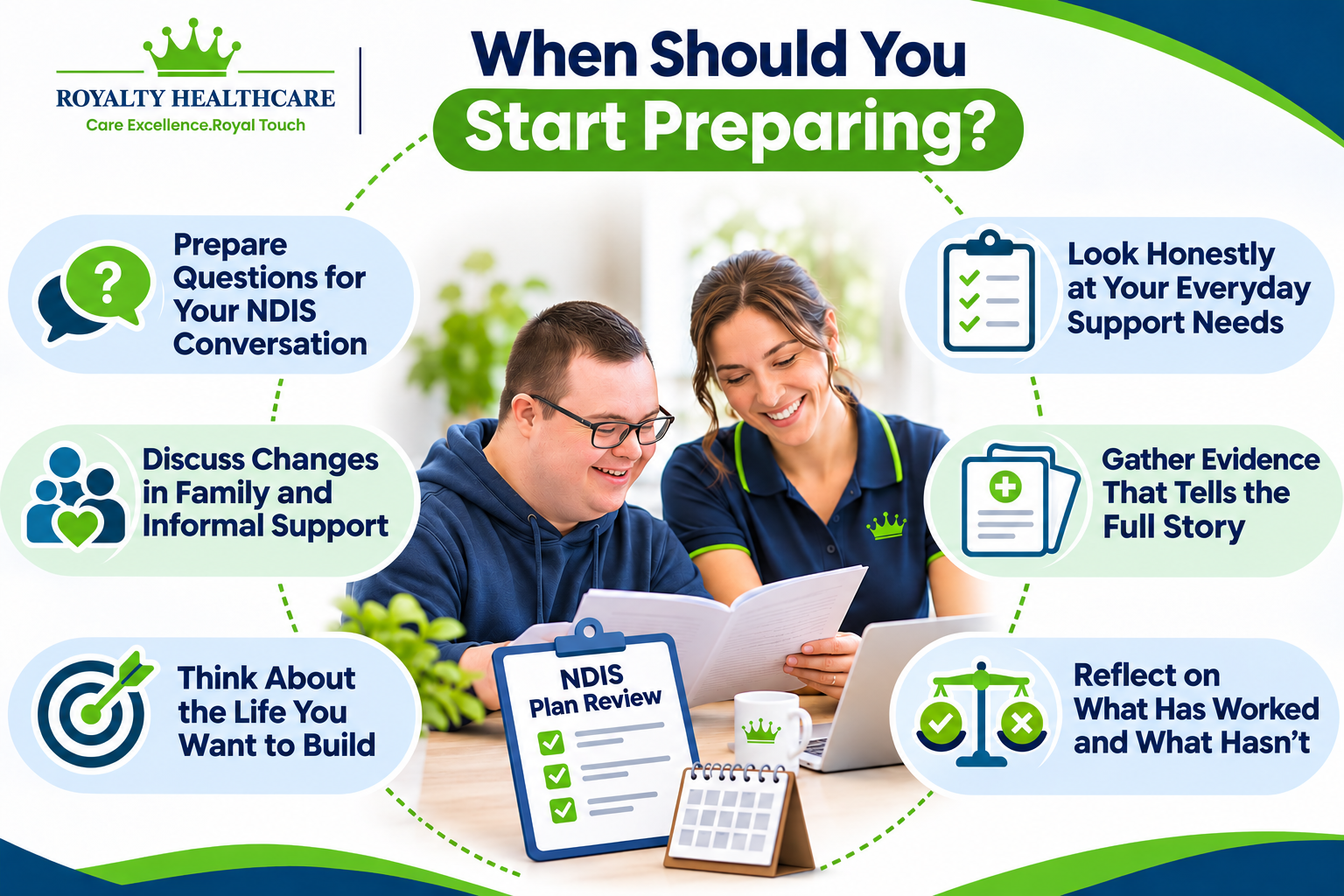
When Should You Start Preparing?
It’s worth thinking about your next plan well before the reassessment date arrives.
The NDIA generally contacts participants around two to three months before their scheduled reassessment date to organise a check-in. This conversation helps determine whether existing supports remain appropriate.
You don’t necessarily need to wait for that contact.
If your circumstances have changed significantly and your ongoing support needs are no longer being met, you can ask about requesting an earlier reassessment.
Consider starting preparations when:
- Your daily living needs have noticeably changed.
- Your current support arrangements are no longer suitable.
- You’re preparing for a major life transition.
- Your family or informal support arrangements have changed.
- New assessments identify different disability-related support needs.
- Your existing supports are helping, but your goals or circumstances have evolved.
Preparing early gives you time to collect meaningful information rather than rushing through everything immediately before a meeting.
1. Look Honestly at Your Everyday Support Needs
One of the most useful things you can do is reflect on an ordinary week.
Not your best day. Not necessarily your hardest day. Think about what daily life typically involves.
Ask yourself:
- Which activities can I manage independently?
- Where do I still need assistance?
- Are there tasks that have become more difficult?
- Which supports have made a positive difference?
- What happens when my regular assistance isn’t available?
Consider personal care, preparing meals, getting around, communicating, maintaining routines and participating in community activities.
For example, you might manage shopping independently when someone helps you plan the journey, but struggle to complete it without that preparation.
That detail matters. It explains both the progress you’ve made and the assistance that continues to support your independence.
Helpful tip: Keep a short diary for a week or two. Record the activities you undertake, assistance received, difficulties encountered and outcomes. Real examples can make your circumstances easier to explain.
2. Gather Evidence That Tells the Full Story
Supporting evidence plays an important role in determining whether changes to your plan are appropriate.
Depending on your circumstances, relevant documents may include:
- Occupational therapy assessments.
- Physiotherapy or other allied health reports.
- Reports from treating healthcare professionals.
- Support worker observations and progress notes.
- Records describing changes in daily functioning.
- Information about your current support arrangements and unmet needs.
The most useful evidence goes beyond identifying a diagnosis.
It explains how your disability affects everyday activities, what assistance is required, what has changed and why particular supports may be needed.
For example, a report stating that someone experiences mobility difficulties provides limited practical detail.
A report describing how those difficulties affect transferring, preparing meals or accessing the community gives a clearer picture.
For participant-initiated reassessment requests, the NDIA generally expects recent evidence, usually from within four months of the request and dated after the current plan was approved.
Check the official NDIS reassessment guidance before submitting your documents.
3. Reflect on What Has Worked and What Hasn’t
A reassessment isn’t only about identifying difficulties. It’s also an opportunity to recognise progress.
Perhaps you’ve developed greater confidence using public transport, improved your daily routines or started participating in activities that previously felt inaccessible.
These achievements help demonstrate how your supports have contributed to your goals.
Equally, be open about areas where things haven’t gone as planned.
Maybe a particular support wasn’t suitable, an essential service was difficult to access, or your needs changed during the plan period.
Try organising your thoughts into three simple categories:
What’s working: Supports that have made everyday activities easier or helped you build skills.
What’s challenging: Difficulties that continue despite your current assistance.
What needs attention: Changes that could make your support arrangements more appropriate.
This approach helps create a balanced picture instead of focusing entirely on what you have or haven’t achieved.
4. Think About the Life You Want to Build
NDIS goals should connect with what matters to you, rather than simply describing services you want to receive.
You might want to feel more confident leaving home, develop skills for independent living, strengthen social connections or prepare for employment.
Consider how your priorities have changed since your existing plan was approved.
For example:
Instead of saying, “I want more community support,” you might explain:
“I want to feel confident attending a weekly community activity, but I currently need assistance planning transport and managing unfamiliar environments.”
That explanation connects your personal goal to the practical barriers you’re experiencing.
You don’t need perfectly worded goals. What matters is that they reflect your preferences and the outcomes you’re working towards.
Remember, requesting a support doesn’t automatically mean it will be funded. The NDIA considers the evidence, applicable funding rules and how proposed supports relate to your disability-related needs.
5. Discuss Changes in Family and Informal Support
Family members, friends and carers often provide valuable assistance alongside funded disability supports.
However, these arrangements can change.
A parent might return to full-time employment. An ageing carer may find certain tasks increasingly difficult. A participant might move away from family or begin living more independently.
If something has changed, explain it during your reassessment discussions.
Be specific about which activities were previously supported, what assistance remains available and where gaps have developed.
You can also talk about community and mainstream services you currently use.
The purpose isn’t to minimise anyone’s contribution. It’s to give the NDIA an accurate understanding of your current circumstances.
6. Prepare Questions for Your NDIS Conversation
It’s easy to remember an important question only after a meeting has finished.
Writing things down beforehand can make the conversation more productive.
Some useful questions include:
- Do my current supports still match my disability-related needs?
- What additional evidence would help explain the changes I’m experiencing?
- How will my current progress and future goals be considered?
- Would a plan variation be more appropriate than a reassessment?
- What happens after the information has been submitted?
- Who should I contact if I don’t understand the outcome?
You can ask for information to be explained in plain language, discuss accessibility requirements, or involve a trusted support person where appropriate.
A family member, nominee or support coordinator may help you prepare, but your own preferences should remain central to the discussion.
What Changed in the NDIS Reassessment Process in 2026?
Changes introduced on 27 August 2026 affect who can request a plan reassessment and how requests must be made.
Only a participant, their plan nominee or child representative can formally request a reassessment.
If you’re requesting significant changes outside an upcoming regular check-in, you must use the appropriate NDIA reassessment request form and provide supporting evidence.
A service provider cannot independently request a reassessment on your behalf.
The NDIA considers the completed request and supporting information before deciding whether a reassessment is needed, a variation is more suitable, or no change should be made.
The NDIA states that it will make its decision within 90 days once it has the required information.
You can find the current process and relevant forms on the NDIS website.
What Happens After Your Reassessment?
Once a decision has been made, take time to understand what it means for your supports.
If you receive a new plan, check the approved supports, funding amounts, relevant funding periods and any conditions that affect how your supports can be used.
Compare the new arrangements with your current support schedule.
If something isn’t clear, ask for an explanation before making major changes to your services.
If you disagree with a reviewable NDIA decision, you can generally request an internal review within three months of receiving that decision.
The NDIS decision review process explains how to do this.
A decision that differs from what you requested doesn’t necessarily mean your evidence was ignored. Understanding the reasons can help you decide what to do next.
Your NDIS Reassessment Preparation Checklist
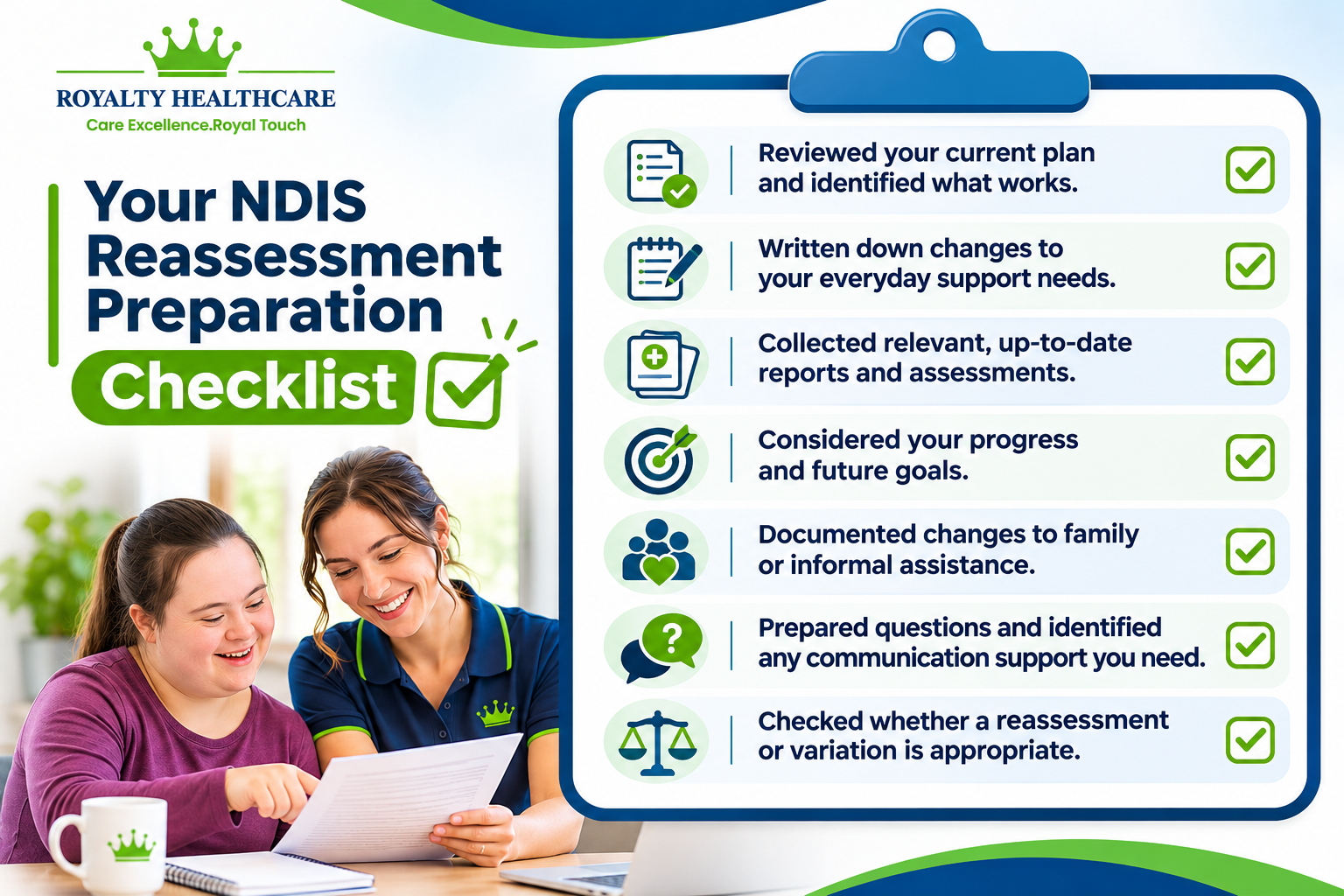
Before your next discussion, check whether you’ve:
- Reviewed your current plan and identified what works.
- Written down changes to your everyday support needs.
- Collected relevant, up-to-date reports and assessments.
- Considered your progress and future goals.
- Documented changes to family or informal assistance.
- Prepared questions and identified any communication support you need.
- Checked whether a reassessment or variation is appropriate.
You don’t need to have every answer before speaking with your my NDIS contact. This checklist simply provides a starting point.
Moving Forward with Confidence
Preparing for an NDIS plan reassessment isn’t about proving that every day is difficult or asking for the largest possible funding amount.
It’s about helping the people making decisions understand your life as it is today.
Your achievements matter. Your changing circumstances matter. So do the small everyday challenges that might not be obvious in a formal assessment.
At Royalty Healthcare, we understand the importance of disability supports that respond to individual circumstances, preferences and goals.
Our team provides NDIS support services across Brisbane and surrounding areas. Where appropriate, service-related observations and progress information can also help participants describe how their current supports are working.
If you’d like to discuss your existing support arrangements or changing service needs, contact Royalty Healthcare on 1800 467 692.
A little preparation today can make your next NDIS conversation clearer, more meaningful and better focused on the life you want to lead.
Disclaimer: This article provides general information based on NDIS guidance available in November 2026. Individual circumstances, planning arrangements and applicable NDIS rules may differ. Always refer to the NDIA for decisions about plan funding and reassessments.