
What Is NDIS Support Coordination and Do You Need It?
Your NDIS plan has finally arrived. It runs to several pages, splits your funding into budgets with unfamiliar names, and lists goals you talked through weeks ago. Then comes the question almost every new participant asks: what do I actually do now?
That gap between having a plan and getting real supports in place is exactly what NDIS support coordination is designed to fill. A good coordinator helps you turn funding on paper into services in your week, and builds your confidence to manage more of it yourself over time.
At Royalty Healthcare, our team works alongside participants, families and carers across Brisbane, and we see how much smoother a plan runs when someone is helping to join the dots. This guide explains what support coordination is, the three levels the National Disability Insurance Agency (NDIA) can fund, what a coordinator does, and how to tell whether you need one.
How Coordination Works in Plain Language
Support coordination is a capacity-building support. Rather than being a hands-on service like personal care or therapy, it helps you understand your plan, connect with the right providers and community services, and develop the skills to coordinate your own supports.
The NDIA decides whether to include it, and at what level, based on your circumstances. Its published guidance points to factors such as the functional impact of your disability and the family, carer and community support you already have.
Two points are worth knowing from the start. Support coordination is paid for from your plan, so every hour a coordinator spends on your behalf draws on that funding. And it is meant to build independence, not replace it. It is not long-term case management, and a coordinator’s success is partly measured by how much less you need them over time.
The Three Levels of Coordination the NDIA Can Fund
The NDIA can include one of three funded levels in a plan. The right level depends on how complex your circumstances are, not simply on your diagnosis.
Level 1: Support Connection
The lightest-touch option. It helps you understand your plan, connect with providers, and link in with community and mainstream supports. It suits people who are fairly confident but need help getting started.
Level 2: Coordination of Supports
This is what most people mean by having a support coordinator. Your coordinator works with you to design and build your mix of supports, understand your funding and coach you to maintain a network of formal and informal support. The NDIA describes the focus as helping you steer your life, rather than only managing your services.
Level 3: Specialist Coordination
Specialist support coordination is a higher level of support for people whose situations are complex and need specialist input. A specialist coordinator works to reduce complexity, remove barriers to appropriate services and negotiate solutions with several stakeholders at once, such as hospitals, housing providers or justice services. It is usually delivered by practitioners with backgrounds in fields like social work, psychology or occupational therapy, and is generally time-limited, with the aim of stabilising things so you can step down to a lower level.
If your disability is psychosocial, your plan may include a psychosocial recovery coach instead of, or alongside, a support coordinator.
What a Coordinator Actually Does Day to Day
Good NDIS plan implementation rarely happens by accident. It depends on many small, practical tasks being done in the right order.
1. Explains your plan in plain language
Your coordinator walks you through each budget, what it can and can’t be spent on, and how your goals connect to the funding. This often clears up the uncertainty that stops people from getting started.
2. Finds and connects suitable providers
They research options, check availability and registration, and present choices that match your needs, culture and location. The final decision always stays with you.
3. Sets up service agreements and schedules
Your coordinator helps you understand pricing and cancellation terms in service agreements, and gets supports booked so they start when you need them.
4. Links you with mainstream and community services
Not everything you need is funded by the NDIS. Connecting you with health, education, housing and community programs keeps your plan funding for what only the NDIS can provide.
5. Keeps an eye on how funding is used
Regular check-ins help ensure your budget isn’t running out early or sitting unused while your needs go unmet.
6. Steps in when things go wrong
If a provider withdraws, you go into hospital or your living situation changes, your coordinator helps rearrange supports and, where needed, tells the NDIA about the change in circumstances.
7. Prepares you for plan reassessment
Coordinators gather progress information and provider reports so your next plan reflects what you actually need.
8. Builds your own skills
A good coordinator shows you how things are done, so you can gradually take on more decisions yourself.
Signs a Coordinator Could Help You
Not everyone needs a coordinator, and some people only need one for a while. These are the situations where it tends to make the biggest difference.
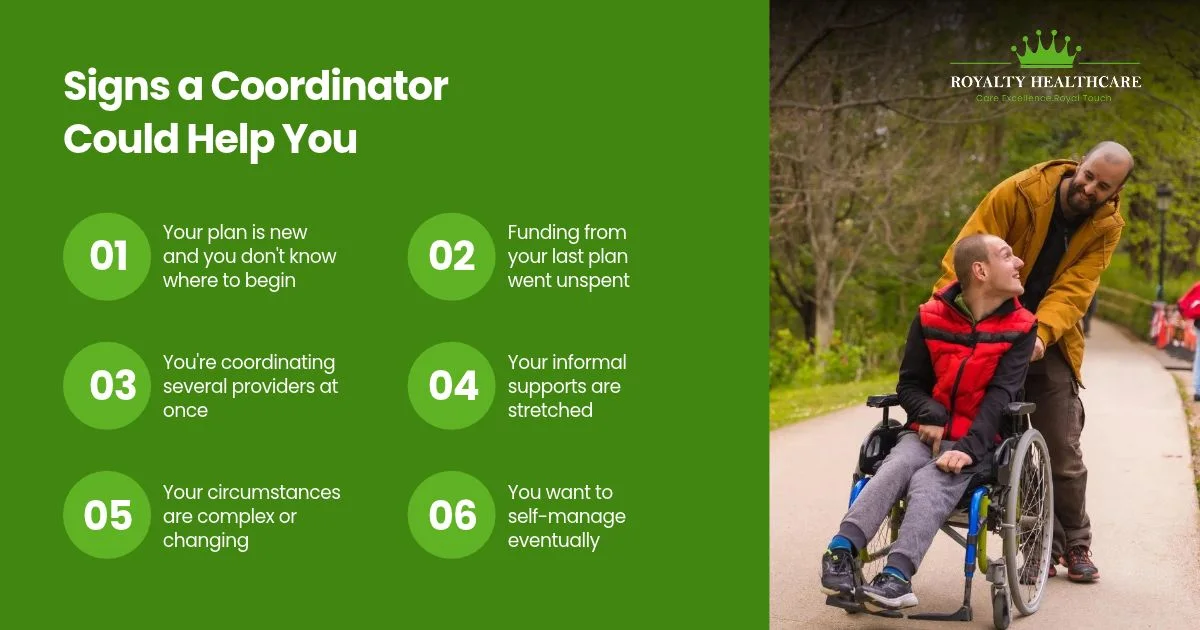
a. Your plan is new, and you don’t know where to begin
First plans bring the steepest learning curve. Early coordination gets supports running sooner and stops funding sitting idle.
b. Funding from your last plan went unspent
Underused budgets usually point to a barrier, such as not finding a provider or not knowing what funding covers. Unspent funding also means goals that went unsupported.
c. You’re coordinating several providers at once
Juggling therapists, support workers, equipment suppliers and a plan manager is a job in itself. A coordinator can lead communication so everyone works toward the same goals.
d. Your informal supports are stretched
If a parent, partner or carer has been holding everything together and is ageing, unwell or exhausted, coordination can relieve that pressure and build a more sustainable network.
e. Your circumstances are complex or changing
Leaving school, moving house, leaving hospital or facing a housing crisis are all points where extra coordination, sometimes at specialist level, can prevent a crisis.
f. You want to self-manage eventually
Time-limited coordination can teach you the skills to run more of your own plan.
If you’re confident with your plan, have reliable providers and strong informal support, you may not need funded coordination at all, and your local area coordinator (LAC) can still help you connect with services. If you believe coordination should be in your plan but it isn’t, raise it with the NDIA and explain why. Reports from treating professionals describing the practical impact of your disability will strengthen the request.
Choosing a Coordinator Who Fits You
Many families start by typing “support coordinator Brisbane” into a search engine and calling the first number that appears. It pays to be more selective, because the right coordinator shapes your whole plan experience.
Start by checking registration, one of the key factors covered in our guide to choosing a registered NDIS provider. Registered providers have been audited against the NDIS Practice Standards and appear on the NDIS Quality and Safeguards Commission’s public provider register, which anyone can search.
Local knowledge matters too. A coordinator who understands the Brisbane service landscape, including which providers have capacity and how Queensland health, housing and education services operate, can move faster than one working from a generic directory.
Finally, ask about conflicts of interest. When one organisation delivers both coordination and other supports, it must manage that conflict transparently, and you keep the right to choose any provider for any support. It’s also worth asking how often you’ll meet and how they’ll report on your budget. The NDIA’s own guide to finding a support coordinator confirms that you choose your coordinator and can change at any time, without waiting for your plan to end.
How Royalty Healthcare Supports Participants in Brisbane
Royalty Healthcare is a registered NDIS provider (ABN 35 654 251 519) with its head office in Strathpine, supporting participants across Brisbane, Ipswich, Logan, the Gold Coast and the Sunshine Coast. Our registration with the NDIS Quality and Safeguards Commission covers support coordination alongside a wide range of NDIS support services, including daily living assistance, supported independent living, community participation, life skills development and community nursing.
That breadth means our team understands how different supports fit together in everyday life. We work with self-managed, plan-managed and NDIA-managed participants, and we involve families and carers wherever the participant wants them involved. Whether you’re setting up your first plan or working through a complicated change, we’ll help you understand your options, and you stay in control of every choice.
The Bottom Line
NDIS support coordination exists to help you put your plan into action, get real value from your funding and build the skills to manage more of it yourself. Whether you need support connection, ongoing coordination or specialist help through a complex period depends on your circumstances, and that can change from one plan to the next.
If you’re unsure whether coordination is right for you, call the Royalty Healthcare team on 1800 467 692 for a friendly conversation about your goals and the supports that could help you reach them.